
How a European Kombucha Co-Packer Stopped Their Bottles From 'Volcanizing'
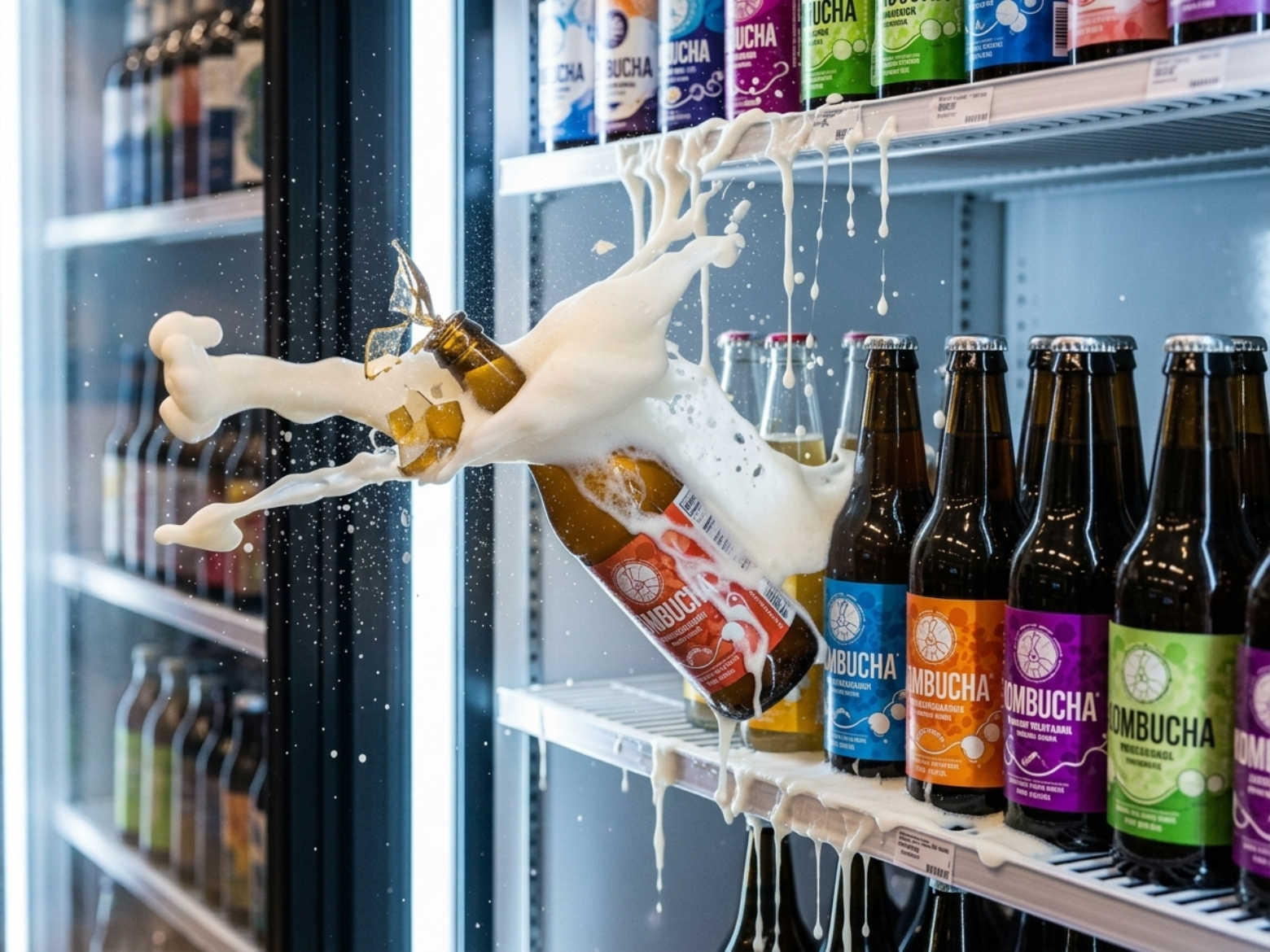
For a large private label kombucha co-packer supplying retailers across Europe, one video changed everything.
A consumer had left a bottle of their kombucha in the fridge while on holiday. When they got back, the bottle had exploded, and they filmed the aftermath. The video went viral.
It wasn't an isolated incident. Bottles and cans across the range were gushing on opening, and in some cases exploding entirely. It's a phenomenon known in the industry as 'volcanizing'. The co-packer had already run a full root cause investigation, but they still couldn't get to the bottom of it.
A Problem Their Retailers Wouldn't Tolerate
Volcanizing is a symptom of uncontrolled secondary fermentation. After kombucha is packed, live yeast and bacteria can keep metabolising residual sugars. That produces excess CO2 and builds pressure inside a sealed bottle or can. It's especially common in traditionally brewed, raw, unfiltered kombucha, where the microbial community stays active even under refrigeration.
For this co-packer, that instability had become a retail risk. Their customers issued an ultimatum: solve the problem and guarantee it wouldn't happen again, or be removed from the range entirely. With consumer trust already dented by a viral video, the business had little room to manoeuvre. Losing that listing threatened to unravel years of growth.
Swapping Volatility for a Stable Foundation
The co-packer brought the problem to Good Culture. Rather than trying to tame an unpredictable in-house starter, they replaced it with Good Culture's stable, fully fermented kombucha bases.
Most commercial kombucha is unstable because the category grew out of small-batch craft fermentation, optimised for flavour rather than control. The living microbiology that gives kombucha its authenticity also makes it hard to stabilise at scale. Many producers lack the expertise, equipment, or process control to manage it fully once volume increases.
Good Culture's bases are produced under tightly controlled, reproducible fermentation conditions, so the microbial and chemical activity is already resolved before the base ever reaches a customer's tank. Swapping it into the recipe removed the volatility the co-packer had been fighting. The volcanizing issue stopped immediately.
A Brand That's Growing Again
With the volcanizing issue eliminated, the co-packer's customers and their own consumers regained confidence in the product. The co-packer has also grown year on year since.
Beyond solving this crisis, the switch gave the co-packer a production process equipped for scale. The product tastes better than before, batches are consistent, and the business can now invest in growth with a process it trusts rather than one it has to manage around.