
Why Outsourcing Kombucha Production Can Save You Time and Money
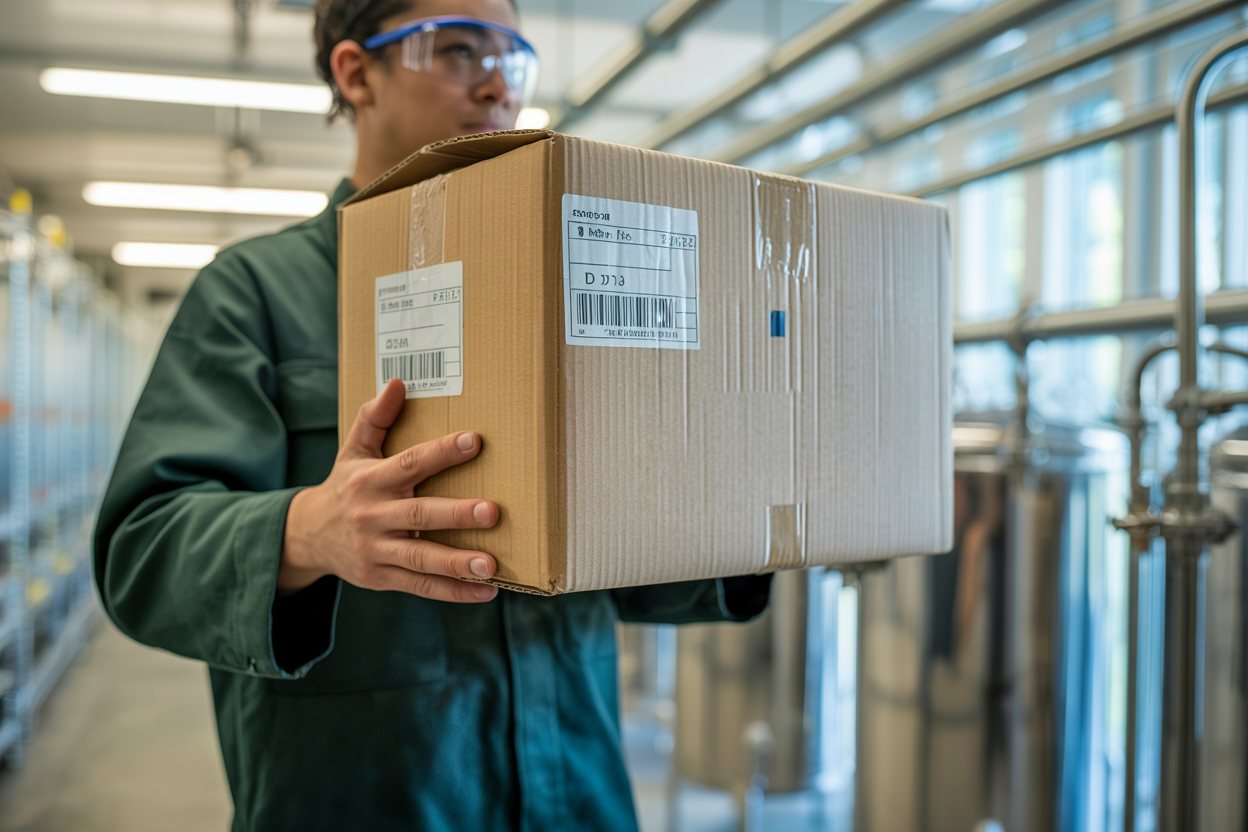
Building a kombucha brand is hard enough without also running a brewery.
Yet many brand owners find themselves doing exactly that – managing fermentation tanks, hiring specialist staff, troubleshooting batches, and trying to keep up with retailer demand, all at the same time.
Outsourcing kombucha production to a co-packer changes that equation. It lets you focus on the parts of the business that build brand value – flavour development, marketing, retail relationships, innovation – whilst leaving the production complexity to people who are set up to handle it every day.
This guide explains how outsourcing works, what the real financial and operational benefits are, and how using pre-fermented bases makes the whole process faster, more consistent and more scalable.
Why Kombucha Production Is Harder Than It Looks
Kombucha isn't like most drinks. It's a live, fermented product that can continue to change after it's made. Temperature, fermentation time, SCOBY health, sugar levels and pH all need to be tightly controlled to produce something consistent enough for retail.
At small scale, that's manageable. At commercial scale, it becomes a significant operational challenge. Batch-to-batch variation is one of the most common issues brands face as they grow. Alcohol drift is another. Both can lead to write-offs, retailer complaints and regulatory problems if they're not managed properly.
Setting up a full in-house brewery to handle this needs significant investment. Equipment, infrastructure, specialist staff, quality testing, cold chain logistics. For most brands, that money is better spent elsewhere. And for those working with co-packers, the answer often lies in changing what goes into the production process, not just who's running it.
What Outsourcing Actually Looks Like
Outsourcing kombucha production doesn't mean handing over your brand. It means choosing where in the production process you focus your time, expertise and investment.
In a co-packing model, you're typically responsible for the recipe, the flavour profile, the brand and the commercial decisions. The co-packer handles the production itself: filling, carbonating, pasteurising if needed, and packaging to your spec.
The most efficient version of this uses high-strength pre-fermented organic tea bases. Instead of the co-packer managing a full kombucha brewery, they receive a concentrated, stabilised fermented base that's already been brewed to tight specifications for pH, ABV and sensory profile. They then dilute, flavour, carbonate and package. That removes the most technically complex and unpredictable part of kombucha production from the co-packing environment entirely.
The result is faster turnaround, lower risk, and a much wider network of co-packers to choose from. Most contract beverage manufacturers are set up to blend, fill and package. But far fewer are set up to manage live kombucha fermentation. Using a pre-fermented base means you're not limiting yourself to specialist kombucha co-packers only.
The Real Financial Benefits
The financial case for outsourcing is strongest when you look at the full picture, not just the cost of ingredients. Every cost you'd carry in a full in-house operation – equipment, staff, testing, write-offs – becomes someone else's overhead. Outsourcing converts those fixed costs into variable ones. You pay for production when you need it, at the volume you need it.
Outsourcing converts most of those fixed costs into variable ones. You pay for production when you need it, at the volume you need. Using ready-to-blend fermented bases sharpens that further. Because the fermentation is already done upstream, your co-packer doesn't need specialist brewing capability or the equipment that goes with it. That means lower co-packing costs, less waste from fermentation issues, and a faster, more predictable production run every time.
Labour costs tell a similar story. Brewing kombucha in-house means hiring, training and retaining staff with specialist fermentation expertise. That's not easy or cheap. Co-packers already have those teams in place. You benefit from their investment without carrying it on your payroll.
How It Supports Consistency and Quality
One of the most underestimated benefits of outsourcing – particularly when using pre-fermented bases – is what it does for product consistency.
Traditional in-house kombucha production introduces variables at every stage of the process. Wild fermentation is inherently unpredictable. Even small changes in ambient temperature, SCOBY health or ingredient quality can shift the taste, carbonation, pH or alcohol content of your finished product. At small scale, that's part of the charm. At retail scale, it's a liability.
Pre-fermented bases remove the most unpredictable variables before they reach your co-packer's line. The fermentation has already happened, under controlled conditions, to a defined spec. Your co-packer is working with a stable, consistent input. That translates directly into a more consistent finished product – the same taste, the same carbonation, the same ABV – every time.
For brands building retail distribution, that consistency is critical. Retailers and consumers expect the same experience every time they pick up your product. Inconsistent batches erode trust quickly, and trust is very hard to rebuild once it's lost.
Scaling Without the Growing Pains
Growth is the goal. But growth in kombucha can be painful if your production model isn't built for it.
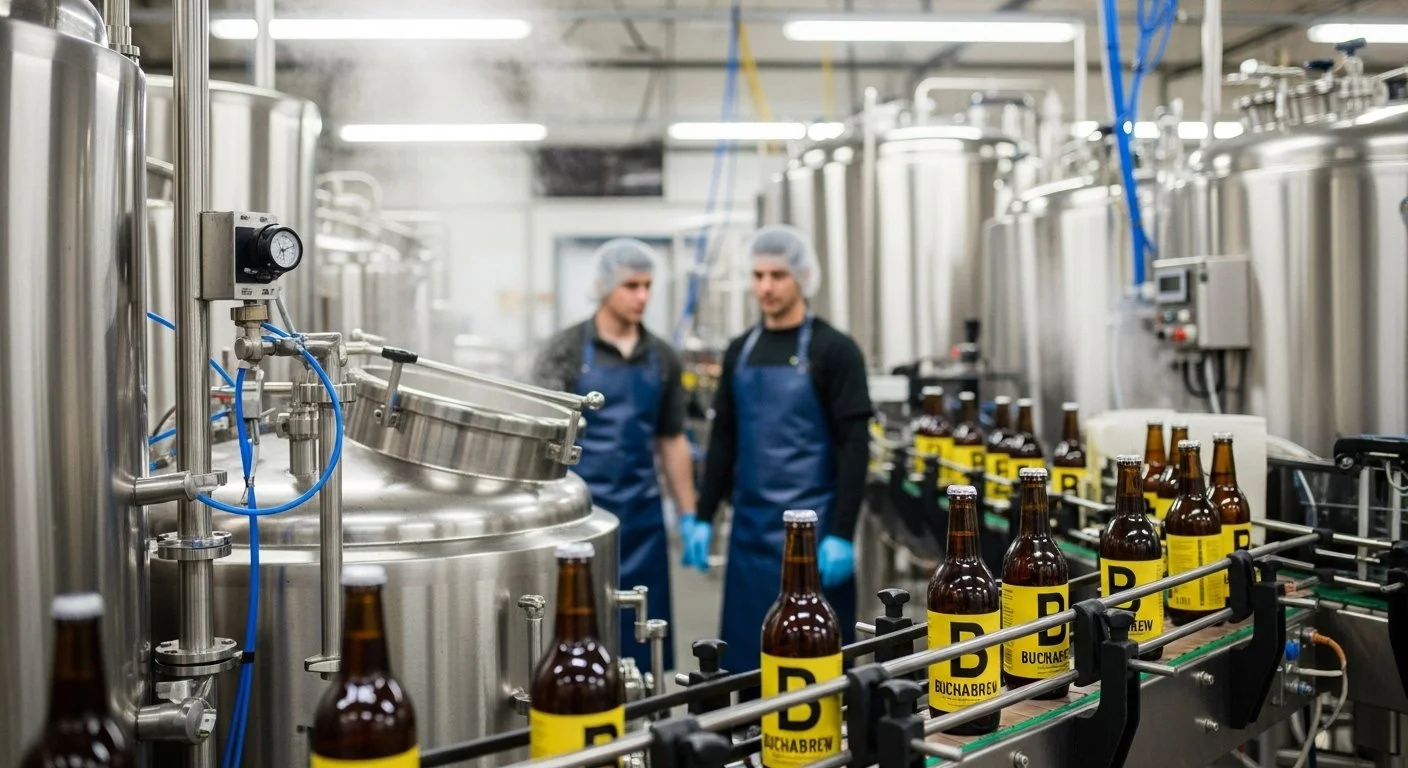
In an in-house brewery, scaling up means more tanks, more space, more staff and more capital. Lead times on fermentation equipment can stretch to months. That means you're often either over-invested ahead of demand, or scrambling to catch up when it arrives.
In a co-packing model built around ready-to-blend fermented bases, scaling is far more flexible. The fermentation capacity already exists. When demand increases, you increase your order. Your co-packer absorbs the production challenge without you needing to expand your own infrastructure. If you need to scale from 100L to 1,000L and beyond, the foundation is already there.
This also makes it easier to test new markets, formats and flavours. A new SKU doesn't need its own fermentation programme. It needs a recipe, a base, and a production run. That dramatically shortens the time from brief to shelf, which matters when you're trying to stay ahead in a fast-moving category.
Choosing the Right Co-Packer for Kombucha
Not all co-packers are equal, and choosing the right manufacturing partner makes a material difference to the quality and consistency of your finished product.
Look for co-packers with experience in fermented or functional beverages. They'll understand the sensory profile you're aiming for, the carbonation dynamics of a fermented base, and the quality standards expected by major retailers. If you're using pre-fermented bases, the technical complexity drops significantly, which opens up a broader range of manufacturing partners.
Good Culture works with a network of co-packers around the world who are experienced in kombucha and fermented beverage production. If you're looking for a manufacturing partner that fits your market, volume and product requirements, get in touch and we can help connect you with the right fit.
Finding the Right Kombucha Co-Packer for Your Brand
Outsourcing kombucha production isn't a shortcut. It's a strategic choice that lets you build a better brand by focusing your energy where it matters most.
If you're weighing up whether to brew in-house or work with a co-packer, start by mapping your current production pinch points. Where is time and capital being consumed that could be better spent on brand, innovation or commercial growth?
Our comprehensive Kombucha Producers Guide covers production models, formulation considerations and practical guidance for brands at every stage of growth. And if you'd like to explore how our ready-to-blend fermented bases could support your production model, get in touch with our team.
FAQ: Outsourcing Kombucha Production
-
Outsourcing kombucha production means working with a contract manufacturer or co-packer to produce your kombucha, rather than brewing in-house. You retain control of the recipe, brand and commercial decisions. The co-packer handles filling, carbonating, pasteurising and packaging to your specification.
-
Pre-fermented bases remove the most technically complex part of kombucha production from the co-packing environment. The fermentation is done upstream to a tight spec, so your co-packer receives a stable, consistent input to dilute, flavour and package. That opens up a wider network of co-packers and significantly reduces production risk.
-
For most brands, yes. Outsourcing converts high fixed costs – equipment, infrastructure, specialist staff – into variable production costs. You pay for what you need, when you need it. Using ready-to-blend fermented bases sharpens that further by removing the need for specialist brewing capability at the co-packing stage.
-
Consistency improves when you use a co-packer with the right experience and a stable input like a pre-fermented base. The most common sources of batch variation in kombucha are in the fermentation stage. Using a stabilised base removes those variables before the product reaches your co-packer's line.
-
Look for co-packers with experience in fermented or functional beverages. Good Culture works with a global network of co-packers experienced in kombucha production. Get in touch to discuss your specific needs and we can help connect you with a suitable manufacturing partner.
-
Yes. One of the key advantages of a co-packing model is flexibility. When demand increases, you increase your order rather than investing in new equipment or facilities. Using ready-to-blend fermented bases makes this even more straightforward, because the fermentation capacity is already there and doesn't need to be rebuilt at every new volume tier.