
What Are Functional Beverages? The Producer's Definition

Walk the drinks aisle of any major grocery retailer and functional beverages are hard to miss.
Gut. Calm. Focus. Immunity. Sleep. Energy. These aren't flavour descriptions. They're the organising principles of the modern drinks fixture, and they're everywhere. From chilled RTD to ambient, from shots to two-litre formats, from premium health stores to the Tesco meal deal fridge.
The category has arrived. But defining what actually makes a functional beverage work commercially is more complex than the signage suggests. And building one that earns its place on that shelf is harder still.
If you'd rather have the full producer's playbook in one place, our Producer's Guide to Functional Beverages covers category market data, formulation strategies, and ten ready-to-blend recipes. Free. This post covers the fundamentals.
The Definition of a Functional Beverage
A functional beverage, or functional drink, is a drink formulated to deliver a specific physiological or psychological benefit beyond basic hydration and nutrition.
That definition does a lot of work. "Beyond basic hydration" is the key phrase. Water hydrates. Juice provides vitamins. A functional beverage is positioned to do something more specific and more intentional than either of those.
In practice, the category covers kombucha, kefir-based drinks, enhanced water, functional sodas, energy drinks, RTD wellness shots, adaptogenic beverages, nootropic drinks. What they share is the intention: an ingredient or set of ingredients chosen specifically to deliver a benefit the consumer is looking for.
What they don't share is a single regulatory definition. In the UK and EU, "functional beverage" has no legal status. Health claims on labels are strictly governed. A brand can only claim that a product "contributes to normal energy metabolism" if that specific claim has been authorised by EFSA, and only if the product contains the qualifying ingredient at the required level.
Most brands winning in this space don't lead on authorised claims. They lead on lifestyle positioning. "Gut" isn't a claim. It's a positioning. Understanding that distinction is one of the first things any producer in this category needs to get right.
What Makes a Beverage Functional: The Four Layers
Every functional beverage, however complex the finished product, is built on the same four-layer foundation.
The base liquid. Water, tea, juice, a fermented liquid. This is the most consequential decision in the formulation. The base sets the natural acidity, the sugar baseline, the flavour ceiling, the production constraints, and often the primary functional story. Get it right and every layer above it becomes much easier to build. Get it wrong and every downstream decision is affected. Our fermented beverage bases sit at this layer, giving producers natural acidity, gut-health credibility, and clean-label status before a single other ingredient gets added.
The core functional ingredients. Probiotics, adaptogens, vitamins, minerals, botanicals, live cultures. These are the ingredients doing the named functional work. Some are inherent to the base (fermented bases carry live cultures, natural acidity, and gut-health association by default). Others are layered in after (magnesium, ashwagandha, vitamin C).
Sweetness. Natural sweeteners, sugar, or none. This layer interacts with both the base acidity and the brand's clean-label positioning. A fermented base naturally skews low-sugar because the fermentation process consumes most of the starting sugars. A neutral water base doesn't, so sweetness has to be added and then managed.
Flavour. Botanical extracts, fruit preparations and natural flavourings all contribute to flavour. This is where the drink becomes something a consumer actually wants to pick up again. Functional credentials get a consumer to trial. But flavour is what gets them to repurchase.
The sequence matters. Producers who start with flavour and try to add function later almost always find the base liquid decision has already constrained what's possible.
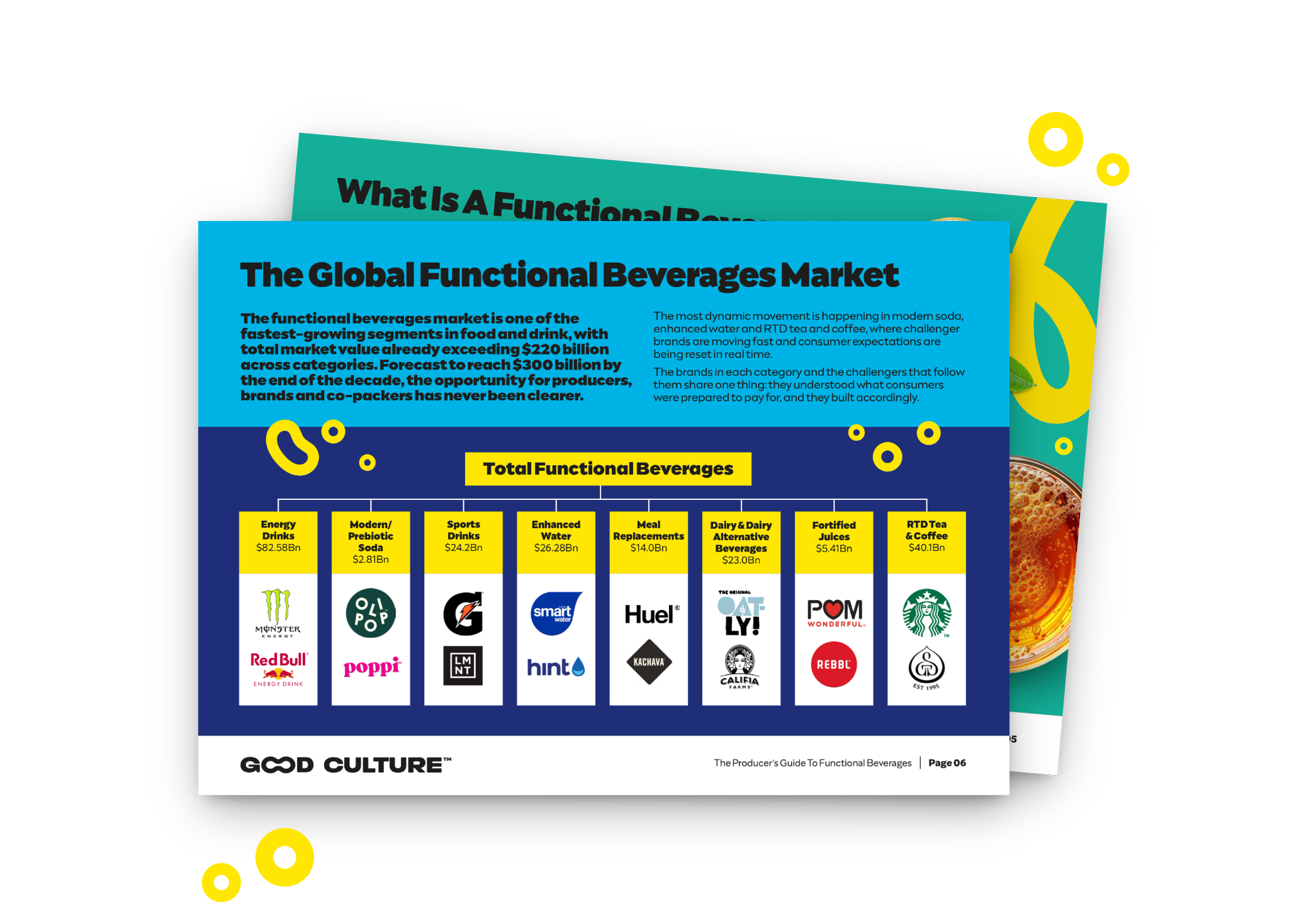
The Functional Beverage Categories Producers Are Winning In
The category is broad enough that "functional beverage" as a single segment is less useful than understanding which sub-categories are showing genuine commercial momentum.
Kombucha is the most established fermented functional category globally, a $5.5 billion market growing toward $16.5 billion by 2035. The credibility of fermentation, live cultures, and natural acidity gives it a stronger functional story than most synthetic alternatives can match.
Modern soda, meaning prebiotic and probiotic sodas in familiar carbonated formats, is the fastest-growing sub-category. Poppi and Olipop proved the format at scale. Pepsi and Coca-Cola have both since moved into the space, which tells you where the biggest players think this is heading.
RTD wellness shots, enhanced water, functional RTD tea and coffee, and adaptogenic drinks are all showing meaningful growth across different regions and retail channels. Our post on the evolution of functional drinks traces how the category got here. For a broader view of what's shaping growth right now, this piece on wellness trends reshaping the beverage industry is worth a read.
What Consumers Actually Want From Functional Beverages
Consumers aren't just looking for a drink. They're looking for a daily ritual with a benefit attached, and that changes how much they're willing to pay, how often they buy, and how loyally they stick with a brand once it delivers. That shows up across eight distinct benefit areas.
Energy — clean, sustained, without the spike-and-crash that synthetic energy drinks carry.
Immunity — particularly post-pandemic, with consumers treating daily drinks as a habitual wellness input.
Gut health — the fastest-growing benefit area in Europe, now mainstream enough to be a Pepsi/Coca-Cola priority.
Cognitive function — focus, clarity, "brain health" positioning that's strongest in the working-age professional segment.
Sleep — evening format drinks with magnesium and botanicals, growing fast in no/low adjacency.
Calm — the counterpoint to energy, and the category Trip and others have built their entire identity around.
Weight management and skin health sit further back in purchase motivation but are growing as the category matures.

Why Fermented Ingredients Are at the Heart of the Category
Fermented ingredients show up across more of those benefit drivers than anything else. Gut health, natural acidity, lower sugar, flavour depth — fermentation delivers all of them as a starting point, not an add-on. And because none of it is synthetic, the authenticity carries through to the label as well as the taste.
Fermentation isn't new. Humans have been fermenting food and drink for thousands of years. What's new is that the mainstream consumer is now seeking what fermentation naturally delivers, at the same moment that the clean-label movement is making synthetic alternatives harder to position credibly.
Good Culture's range of organic fermented bases sits at this intersection. They're long-fermented, up to six months at commercial scale, and they arrive batch-consistent, always under 0.5% ABV, and ready to blend straight in. The fermentation work is already done by the time it reaches you, which means your R&D team gets to spend its time on the layers above the base instead of managing a fermentation programme. If you want to understand what's actually happening at an ingredient level, our fermentation 101 post walks through the mechanics.
The fermented base isn't one of many options for building a functional beverage. It's the foundation the strongest brands in this category have consistently built on.
Entering the Functional Beverage Market as a Producer
The $213.7 billion global functional beverage market is forecast to reach $300 billion by the end of the decade. The opportunity is real.
But the category has moved. Two years ago, "functional" was enough of a differentiator on its own. Today it's the baseline expectation. The brands entering now aren't competing with the mainstream anymore. They're competing with other functional brands, on clean label, on taste, on production credibility, and on whether they can hold a major retailer listing without reformulating eighteen months in.
That's a different problem than building something novel. It's a problem of foundations. Which is why the ingredient decision matters more now than it did at the start of the category's growth phase. A product built on a credible, naturally functional base doesn't just have a better story. It has a structurally better position — one that gets harder to undercut as the category matures and the bar keeps rising.
If you're building something in this space, our free Producer's Guide to Functional Beverages walks the full framework. Market data, formulation strategies, and ten ready-to-blend recipes across the key functional categories.
Frequently Asked Questions
-
A regular drink is bought primarily for taste and hydration. A functional beverage is formulated to deliver a specific benefit on top of that — gut health, energy, calm, immunity, cognitive function, and so on. The "functional" part refers to the intention behind the formulation, not just the presence of added vitamins or a health claim on the label. Some of the most credible functional drinks carry no specific health claims at all — they lead on lifestyle positioning instead.
-
The term "functional beverage" itself isn't regulated in the UK or EU. What is regulated are the specific health claims you can make about what a product does. EFSA maintains a register of authorised nutrition and health claims, and products making those claims need to qualify nutritionally. Most brands in the category avoid the register altogether and lead on lifestyle language instead — "Gut", "Calm", "Focus" — which carries the association without carrying the regulatory burden of a specific claim.
-
Probiotics and live cultures for gut health. Adaptogens like ashwagandha and lion's mane for calm and cognitive function. Natural caffeine and B vitamins for energy. Magnesium for sleep and calm. Botanicals for immunity. The most commercially successful functional beverages build their functional credentials into the base liquid rather than adding functional ingredients to a neutral base — fermentation delivers gut health, natural acidity, and clean label as structural properties of the ingredient itself.
-
Start with the base liquid, not the flavour. The base decision sets your natural sugar level, your acidity profile, your shelf-life parameters, and what your co-packer can run. Producers who start with flavour and add function later usually find the base has already constrained their options. If you're new to the category, our Producer's Guide to Functional Beverages walks the full development framework.