
The Global Functional Beverage Market: Size, Growth, and What It Means for Producers
What's the biggest indicator that a category has arrived? It's when the companies with the most to lose from it start buying into it.
In May 2025, PepsiCo paid $1.65 billion for Poppi, a prebiotic soda that didn't exist a decade earlier. Two weeks later, Coca-Cola launched Simply Pop, its own prebiotic soda, straight into the same category. Pepsi moved first because they recognised where things were going and wanted to own a piece of it before the window closed. Coca-Cola followed because they couldn't afford not to. When the two largest soft drink companies in the world move in the same direction in the same year, the category isn't a trend anymore. It's the market.
This post breaks down what that market actually looks like: the size, the fastest-growing segments, what's driving growth, where the regional opportunities sit, and what it means if you're building in this space right now. If you'd rather have the whole framework in one document, our Producer's Guide to Functional Beverages has the market data, formulation strategies and ten ready-to-blend recipes in one place. Free.
How Big Is the Functional Beverage Market?
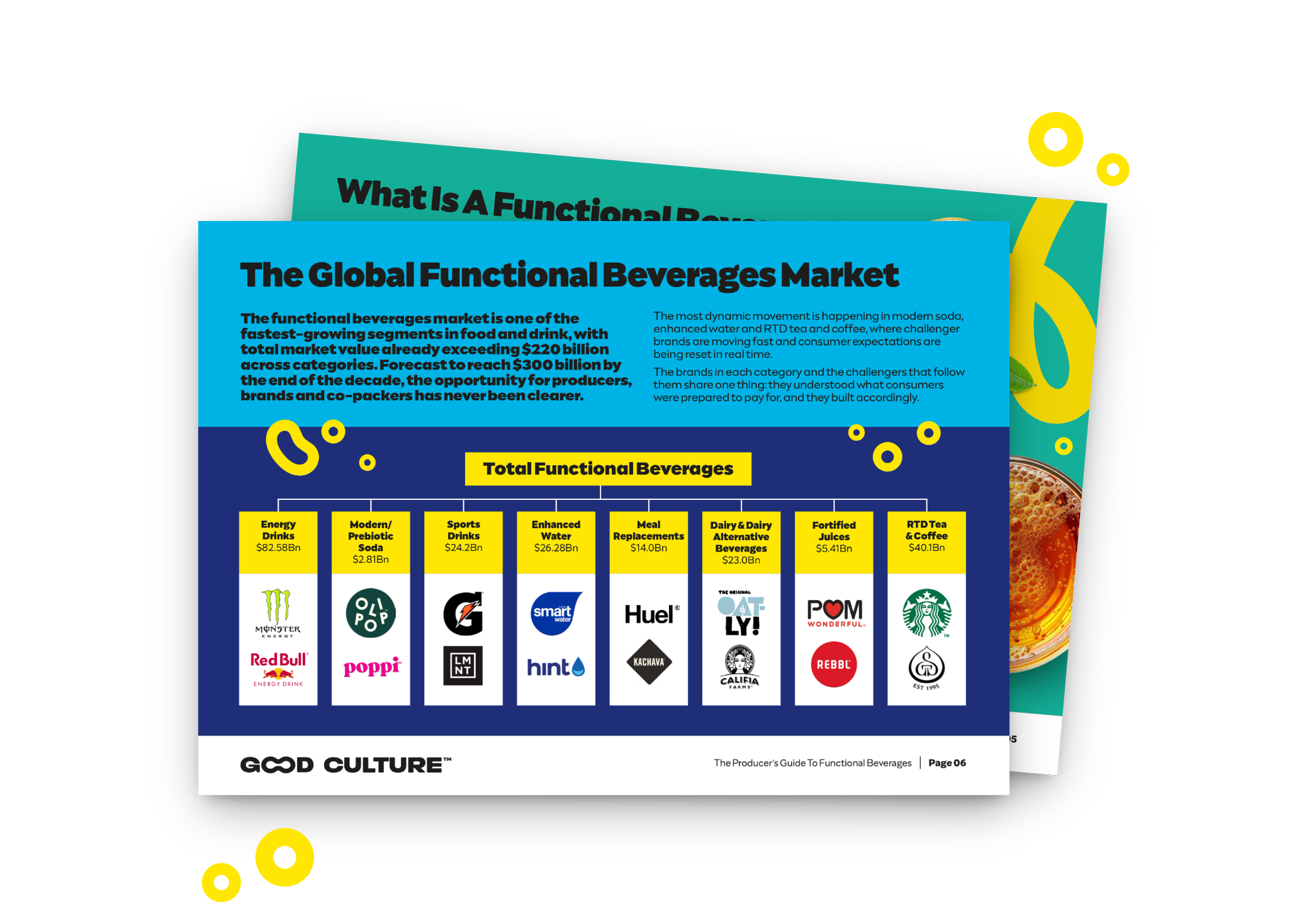
The global functional beverage market sits at around $213.7 billion today. It's forecast to reach $300 billion by the end of the decade.
That's not a niche carving out space inside soft drinks. It's a structural shift in what "a drink" is expected to do. Ten years ago a beverage's job was to taste good and quench thirst. Today a meaningful share of the category is expected to do something else too: support gut health, deliver energy without a crash, help you sleep, help you focus, help you feel calmer.
The growth isn't evenly spread. Some segments are already large and growing steadily. Others are small today and growing fast enough that they'll matter within a few product development cycles. Knowing which is which changes where you place your next launch.
Which Functional Categories Are Growing Fastest
Four categories tell most of the story.
Energy drinks are the largest functional category by value, at roughly $82 billion. It's mature, competitive, and dominated by a small number of global brands, but functional positioning inside energy, meaning clean-label, natural caffeine, no-crash formulations, is still opening space for challenger brands.
RTD tea and coffee sits around $40 billion. Growth here is coming from functional layering: probiotics added to iced tea, adaptogens added to cold brew, kombucha-based RTD blends. The category was already large; function is what's making it grow again.
Enhanced water is worth roughly $26 billion. Electrolytes, vitamins, and increasingly gut-health additions are turning what used to be a commodity category into a functional one.
Modern soda is the smallest of the four by value, at around $2.8 billion, but it's the fastest-growing. This is Poppi's category, and Simply Pop's, and it's the clearest evidence of where consumer appetite is heading: familiar formats, genuine functional credentials, mainstream distribution.
The pattern we’re seeing across all four: the categories growing fastest aren't the ones inventing new occasions. They're the ones adding real function to formats consumers already understand and already buy.
What's Driving Growth: The Five Forces Reshaping the Market
Five forces are doing most of the work.
Consumer health investment. Health spending has shifted from occasional to habitual. Consumers aren't buying a wellness drink as a treat. They're building it into a daily routine, which changes purchase frequency and brand loyalty.
Trading up. Consumers are willing to pay a premium for a drink that does something, provided the something is credible. Functional positioning supports pricing that a standard soft drink couldn't carry.
Tailored wellness. Generic "healthy" claims don't sell the way they used to. Consumers want gut health, or calm, or focus, or immunity, specifically. Category segmentation by benefit is accelerating, not consolidating.
Convenience. Functional benefits used to require a supplement aisle. Now they're available in a can, in the same fridge as everything else. That accessibility is expanding the buyer base beyond committed wellness consumers into mainstream grocery shoppers.
Clean label. Consumers are rejecting ingredients they don't recognise, and rewarding brands that can point to a that’s genuinely natural and functional. This force matters because it shapes what a producer can put in the bottle, not just what the marketing team can say about it afterwards.
Each of these forces reinforces the others. A consumer trading up for a premium functional drink expects that drink to have a clean label. A consumer buying a tailored-wellness product expects the convenience of finding it on a normal shelf. Those forces compound, which is why the growth curve keeps steepening rather than flattening.
The Regional Picture: Where the Biggest Opportunities Sit
Growth isn't uniform geographically either.
North America is retail-led and the most mature functional beverage market globally. Category structures are established, consumer education is high, and competition for shelf space is intense. Winning here is about differentiation inside an educated category, not category creation.
Europe is the early-mover opportunity. Roughly 60% of European consumers don't yet recognise kombucha as a category, which sounds like a weakness but is actually the opportunity: the education work that's already been done in North America hasn't happened here yet. Brands moving early in Europe are building category awareness alongside brand awareness, which is a harder job but a bigger prize.
Asia-Pacific is the fastest-growing region globally, expanding at around 14.4% CAGR. Tea, fermentation, and traditional wellness remedies are already part of everyday life across much of the region, so a functional beverage doesn't need to convince consumers the underlying idea is credible. It just needs to convince them to buy this particular product. Brands entering Western markets usually have to do both jobs at once.
The Middle East is a smaller but distinct opportunity, concentrated around Halal-certified premium functional products. It's a niche within a niche, but one where certification does real commercial work rather than just checking a compliance box.
What the Market Data Means for Producers Right Now
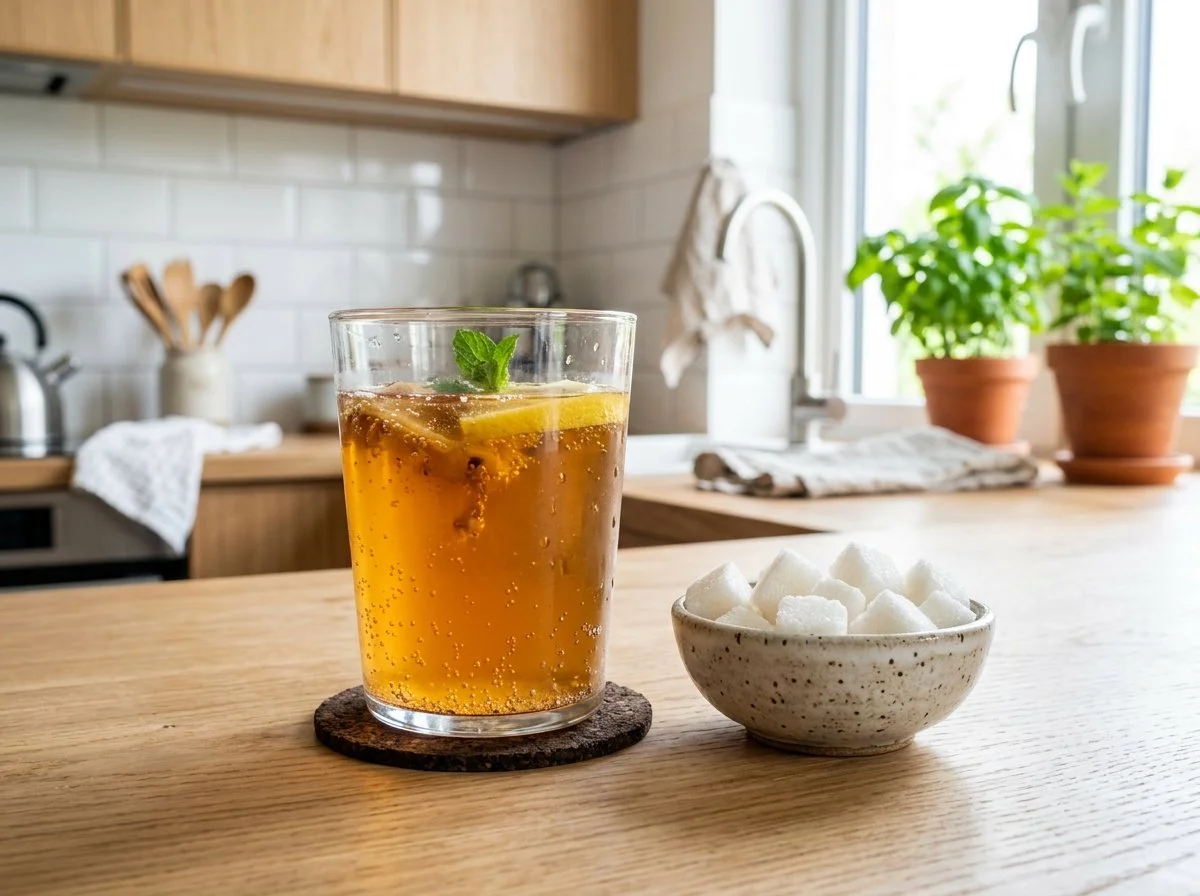
There's a regulatory accelerant sitting underneath all of this. 116 countries now tax sugary drinks in some form, and thresholds keep tightening. The UK's Soft Drinks Industry Levy is a good example: the sugar threshold that triggers the tax drops to 4.5g per 100ml in 2028, which will pull a meaningful share of currently-exempt products into scope. Reformulation isn't optional anymore in most major markets. It's a scheduled event.
Put the growth data and the regulatory pressure together and one shift becomes clear: the market wants authenticity, clean ingredients, and real functionality, all at the same time, and the law is starting to demand it too.
Fermented bases give you all three at once. Natural acidity instead of synthetic acidifiers. A real gut-health mechanism instead of a claim bolted onto the label. Naturally lower sugar because the fermentation process has already used most of it up, not because someone reformulated after the fact. None of that is a coincidence. It's why fermentation keeps showing up across every one of the fastest-growing categories above, from RTD tea to modern soda.
The commercial proof is already on shelf. Good Culture's bases are used in products stocked at Tesco, Whole Foods, Walmart, Costco and Carrefour, among others. That's not a small-scale artisan story. It's evidence that a fermented, ready-to-blend base can support genuinely mainstream distribution, not just a niche health-store slot. We've written more about how a standardised base holds up at that kind of scale in our post on what a standardised fermented base can do for your production.
The window is open. But it isn't open indefinitely, and it isn't open evenly. The brands winning right now moved early and built on ingredient foundations that could carry both the functional claim and the clean-label expectation without a rework down the line.
How to Position Your Brand for the Next Phase of Growth
The first phase of this market rewarded speed. Anyone credibly first with a gut-health, calm, or energy positioning captured attention that's harder to win today, now that the shelf is crowded.
The next phase rewards something different: the ability to move fast without cutting corners on the things that are about to become non-negotiable. Clean label. Genuine functional credentials. Formulation that holds up under sugar tax scrutiny. Supply chain that can scale into mainstream retail without a capital-intensive fermentation build-out.
That's the positioning question every producer entering this market now needs to answer. Not "is there room in the category", because the data says clearly there is. The real question is whether your ingredient foundation can carry you through the next three years of tightening regulation and rising consumer expectation, or whether you're building something that'll need reformulating the moment sugar regulation tightens further
We've covered the demand side of this shift in more detail in our post on kombucha market trends and consumer demand. And for a broader read on where things are heading, our post on how wellness trends are reshaping the beverage industry rounds out the picture.
If you're planning where to place your next product in this market, our Producer's Guide to Functional Beverages walks through the full framework: market data, formulation strategies, and ten ready-to-blend recipes. Free.
Download the Producer's Guide to Functional Beverages to see where the data points for your next build.
Frequently Asked Questions
-
Around $213.7 billion globally right now, forecast to reach $300 billion by 2030. That's growth across nearly every major beverage category, not just a handful of standout brands. Energy drinks are the largest segment by value, but modern soda, the category Poppi and Simply Pop both sit in, is growing the fastest even though it's currently the smallest.
-
Five things, mostly reinforcing each other. Consumers are treating wellness as a daily habit rather than an occasional treat. They're willing to pay more for a drink that does something specific, whether that's gut health or energy or calm. And they're increasingly rejecting ingredients they don't recognise, which is pushing the whole category toward cleaner, more natural formulations rather than synthetic functional additives.
-
Depends what you're optimising for. Asia-Pacific is growing fastest, at around 14.4% a year. Europe is the earlier-stage opportunity, since most European consumers still don't recognise categories like kombucha, which means the education work hasn't been done yet. North America is the most mature and the hardest to differentiate in, but also the market with the clearest evidence of what winning actually looks like.
-
Significantly, and it's accelerating. 116 countries now tax sugary drinks in some form. In the UK, the sugar threshold that triggers the Soft Drinks Industry Levy drops to 4.5g per 100ml in 2028, which will pull products that are currently exempt into scope. Brands building on naturally low-sugar bases, rather than planning to reformulate later, are positioned better for where the regulation is heading rather than where it currently sits.