
Beverage Product Development: How to Build a Functional Drink That Actually Scales
Around 85% of new consumer packaged goods fail. In beverages, that number gets worse.
Most new drinks never make it past prototype. Of the ones that do, most don't survive their first year on shelf. And it's rarely because the product itself is wrong. It's because the beverage product development process didn't account for the gap between a great recipe and something a factory can actually reproduce, batch after batch, without you standing over it.
That gap is where most launches quietly die. Closing it earlier is what separates the brands scaling cleanly from the ones re-formulating their way through year one.
If you'd rather have the full framework in one place, our Producer's Guide to Functional Beverages has it — market data, formulation strategies, and ten ready-to-blend recipes. Free. This post walks the process.
The Five Stages of Beverage Product Development
Every functional beverage moves through the same five stages. The difference between clean development and messy development is how much of each stage is really done before you commit to the next one.
Concept and brief. Who's buying, what functional promise the drink is making, what shelf it's earning, what price point it has to hit, what format and channel it's built for. Leave any of that vague and you'll feel it later, usually at the worst possible moment.
Ingredient selection. The base, the functional inputs, the sweetener system, the acidity source. This is where the choices that constrain everything else get made, often before anyone realises how much they're locking in.
Formulation and sensory testing. You're on the bench now, tasting and re-tasting, adjusting mouthfeel, chasing the right aroma. Panels and internal tastings run until the drink actually matches what the brief promised.
Production validation. Scaling from bench to pilot batch to full production. This is where formulations that behaved at 5L start behaving differently at 5,000L. pH shifts, aroma volatiles drop out, sediment forms where none did on the bench.
Retail readiness and compliance. Shelf-life testing, nutritional analysis, allergen and labelling compliance, certifications, CoAs. Every retailer stacks its own onboarding requirements on top of the regulatory floor.
On paper the five stages run in order. In reality they don't. Something you decide early can force expensive rework much later, and a shelf-life test that fails near the end can send you right back to reformulating. That's usually where things quietly go wrong.
Where Most Functional Beverage Development Goes Wrong
Here's the pattern most brands don't see coming.
You nail the flavour at bench scale. Internal panels love it. The retailer buyer nods. You move to production. The recipe stops behaving. Or it scales fine but the co-packer can't run it without reformulation. Or the shelf-life test fails four months in and the launch is already committed.
Sometimes it really is the flavour. But more often, the flavour was fine and the process let it down. Development got treated as a recipe exercise when it needed to be a supply chain one from the start.
A recipe is a set of proportions on a bench. A supply chain is what happens when those proportions have to be sourced consistently, scaled predictably, held stably, and reproduced by someone else without you in the room. Most development processes solve those two problems in sequence: recipe first, supply chain later. Which is how you end up with a prototype that tastes right and can't scale.
The brands that scale cleanly build the supply chain assumptions into the concept brief. And that starts with the ingredient that carries the whole thing.
The Ingredient Decision That Determines Everything Downstream
Every functional beverage sits on a base. Water. Juice. Tea. A fermented liquid. That single choice decides more than any other input in the formulation.
The base sets the acidity, which controls shelf stability and how the flavour lands. It sets the natural sugar baseline, which decides how much sweetener you can add before the clean-label story falls apart. It sets the flavour ceiling, meaning how much complexity the finished drink can carry before you need a flavour house involved. It sets the ABV floor, which matters for anything fermented. And it sets the story the label can tell.
Every downstream problem in beverage product development is easier to solve if the base is right, and much harder to solve if it isn't.
Get the base wrong in a few common ways and you feel it later. Choose a synthetic acidifier early and you inherit a clean-label problem the moment the label gets written. Choose a base that isn't stable at ambient and you inherit a distribution problem the moment it needs to sit on a truck or a shelf. Choose a base with batch-to-batch variation and you inherit a compliance problem the first time a retailer asks for your CoA history.
Natural fermentation solves several of these structurally. The acidity is organic. The flavour depth is inherent. The gut-health story is real. But fermentation is hard to control at commercial scale, which is why most brands wanting the fermented positioning don't ferment in-house. Our post on natural acidity versus analogue acidifiers unpacks that trade-off in more detail.
The smarter move, and the one the brands scaling fastest are making, is a ready-to-blend fermented base. Fermentation happens elsewhere, at scale, under standardised conditions. It arrives with a documented spec, verified ABV, and a certification pack included. Our range of fermented ingredients sits in that category.
How to Reduce Development Timelines Without Cutting Corners
Every stage of your development process takes time. Most of that time is you waiting. Waiting for a fermentation cycle. Waiting for a shelf-life test. Waiting for a co-packer slot to open up.
Compressing that isn't about rushing. It's about cutting the steps you don't actually need to be doing yourself.
The biggest single compression you can make is taking in-house fermentation off your critical path. Develop, validate and scale your own fermentation programme and you're looking at a development window measured in quarters, not weeks. Fermentation is a specialist discipline, and doing it well at commercial volume takes years of tuning most emerging brands simply can't afford to fund themselves.
This is where we fit into your process. Our organic fermented bases arrive with the fermentation work already done. Long-fermented up to six months at commercial scale, batch-consistent, always under 0.5% ABV, and shipped ready for you to blend. Certifications sit at the ingredient level already: SQF/GFSI, USDA Organic, EU Organic, Soil Association, Kosher, and Halal. That leaves your R&D team free to focus on flavour, format, and functional positioning, which is where your actual competitive edge sits.
The effect is something you can easily measure. Lead times that would ordinarily run to weeks collapse to a day. The sourcing, fermenting and quality-checking you'd otherwise be doing inside your own development cycle has already happened before the base reaches you. We've written more about the front-end compression in our post on fast-tracking kombucha development, and about what a standardised base changes downstream in this piece on standardised fermented bases.
None of this means skipping work. It means not doing work that adds time without adding value, when your real edge is in the finished drink, not in running your own fermentation programme.
From Prototype to Co-Packer: Building for Production from Day One
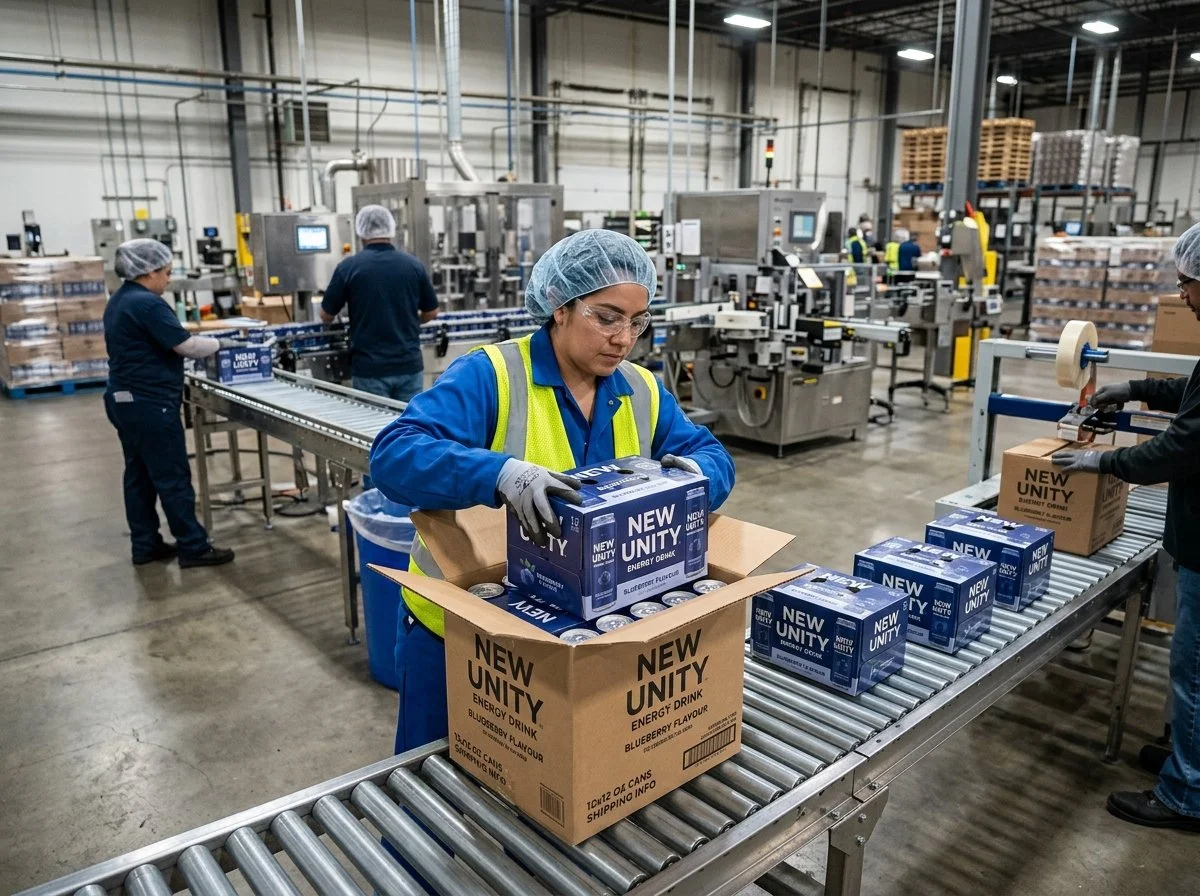
Your prototype exists on a bench. Your commercial product exists on a co-packer's production line. The gap between those two things is where most late-stage development failures actually happen.
The co-packer relationship is one of the highest-leverage decisions you'll make. A good co-packer accelerates your scale-up, absorbs seasonal demand, and lets you run lean on capital. A bad fit, or a good fit stuck with the wrong prototype, turns every batch you run into an exception. Our Co-Packing Network page walks through how to scope and structure the right fit.
There are two things make that integration clean: standardised ingredients and a standardised process.
Standardised ingredients mean your co-packer isn't solving a supply chain problem before they can even run a batch. A base that arrives with a documented CoA, consistent acidity, predictable ABV, and known blending behaviour slots into an existing tea or soft drinks line without a specialist retrofit. Every batch runs the same way as the last one did.
Standardised process means you've designed your recipe for the co-packer's kit, not against it. Dilution ratio, blending sequence, pasteurisation profile, fill and closure, all built around what the production line can actually do, not what worked on your bench. Our post on optimising a recipe for kombucha co-packing walks through the process in more depth.
The brands that scale cleanly are the ones who built for the co-packer from day one. The ones who end up stuck with a single co-packer, or locked out of the co-packer market altogether, are usually the ones who treated production as an afterthought.
The Development Process in Practice: A Working Example
The clearest way to see this is to walk through a real one. A leading global retailer wanted to enter the functional beverage category with a benefit-led enhanced vitamin water range. Something clean-label, gut-friendly, and launch-ready, without building fermentation capability from scratch or committing to a multi-year CAPEX plan.
Here's how the five stages ran.
Stage 1. Concept and brief. The team locked the positioning: a "good gut" enhanced vitamin water range, sitting inside the retailer's wider healthier food and drink push. Flavours: dragon fruit, peach, lime. Functional promise: probiotics, added fibre, natural fermentation credibility. Retail target: own-brand functional set, national distribution. Commercial constraint: launch without significant new-build CAPEX.
Stage 2. Ingredient selection. Water kefir was the base decision. Naturally fermented, light, refreshing, and gut-associated — the ingredient telling the functional story before the label even spoke. Good Culture's Organic Fermented Water Kefir Base was selected: long-fermented, batch-consistent, high-strength, ready to blend.
Stage 3. Formulation and sensory testing. With the base validated at the ingredient level, the R&D team focused on the finished-drink profile. Flavour system, sweetness balance, functional layer (added probiotics and fibre), carbonation, mouthfeel. Iteration was on the drink, not on fermentation control.
Stage 4. Production validation. Because the base ships batch-consistent and pre-certified, the pilot batch behaved the same as the bench recipe. Blending ran on existing production assets. No bespoke fermentation kit. No new factory space. What could have been a brewing cycle measured in weeks or months became a production process measured in days.
Stage 5. Retail readiness and compliance. Certifications sat at the ingredient level. ABV landed reliably under the 0.5% retail-and-tax threshold. The CoA history was documented across every batch.
The launched range hit shelves nationwide and became a customer hit. More importantly, it did so without significant new production infrastructure being built. The full case study is here if you want the commercial detail.
The Development Choices That Compound
Beverage product development is a recipe exercise for the first stage. Everything after that is a supply chain problem in disguise.
The brands scaling successfully treat it that way from the concept brief. They front-load the ingredient decision. They build for the co-packer from Stage 1. They test for production reality at the bench, not at the pilot. And they don't try to do fermentation themselves unless fermentation is their actual business.
The base is the decision carrying the most weight. Get it right and the whole process compresses. Get it wrong and every subsequent stage inherits a problem that costs more to fix the further downstream it's found.
If you're planning a build or a reformulation, our Producer's Guide to Functional Beverages is worth downloading. Market data, formulation strategies, ten ready-to-blend recipes. Free.
Schedule a no-obligation formulation consultation with our R&D team to talk through your next project.
Frequently Asked Questions
-
Most functional beverage development cycles run from 8 to 24 weeks between brief and commercial sign-off. Programmes that include developing an in-house fermentation capability are measured in quarters, not weeks. Starting from a stabilised fermented base compresses the middle stages significantly, particularly stability testing and scale-up, which are where most time gets lost.
-
Failure at scale rather than failure at prototype. A recipe that works at 5L on a bench often breaks at 5,000L in production. pH shifts, aroma volatiles behave differently, sediment forms unexpectedly. Development processes that don't test for production reality early tend to discover this after retail commitment, which is where launches actually fall over.
-
Most emerging beverage brands scale through a co-packer relationship. In-house production ties up capital that's better spent on brand and distribution in the early years. The decision that matters more is which ingredient base you build on. A standardised, pre-validated base makes the co-packer relationship far easier to establish and manage.
-
Before ingredient selection is finalised, ideally. The base decision constrains every downstream input, so involving a specialist supplier while the brief is still being shaped surfaces production and compliance considerations before they become expensive to change. Suppliers who ferment at commercial scale have visibility into shelf stability, ABV control, and regulatory positioning that in-house R&D often doesn't.