
Kombucha founders can tell you exactly what their product tastes like.
Fewer can tell you precisely which category of the market they're competing in - and what that decision means for their production approach, their price point, and their route to retail.
Those are the same decision.
The kombucha category isn't one thing anymore. It runs from premium, long-fermented artisanal brews sitting in a Whole Foods chiller at £4.50, to mainstream sugar-free formats disrupting conventional soft drinks at £1.99 on a Lidl shelf. Both can be winning positions. But the production model, cost structure, and certification requirements that make each one viable are different.
Knowing which category you're building for is the starting point for every product decision you'll make.
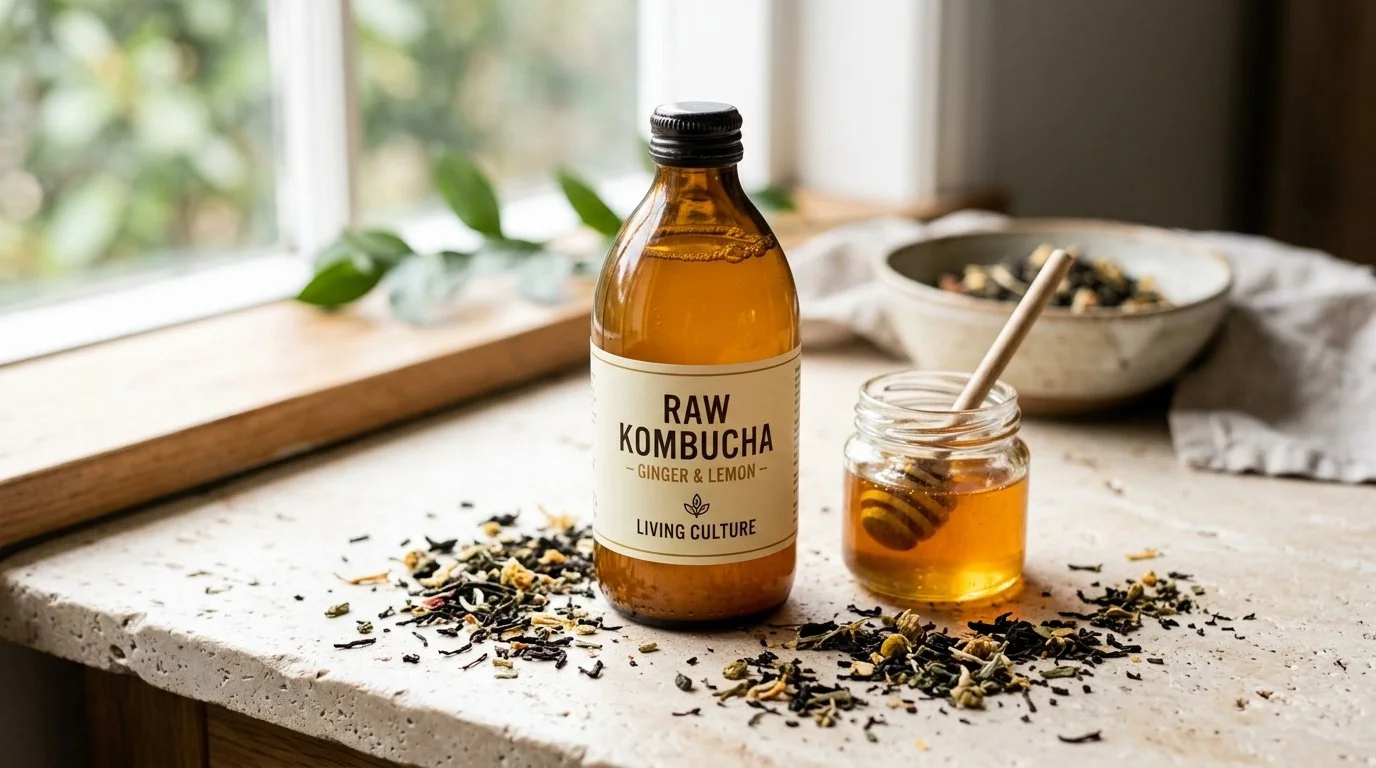
The Kombucha Category in 2026 - A Market With Six Distinct Positions
Six sub-categories now make up the kombucha landscape, each with its own commercial logic, consumer profile, and production demands. Understanding where your brand sits - and where it's headed - changes how you think about almost everything downstream.
Premium / Traditional - £3.49-£4.99 / $3.99-$4.99 / AU$3.50-$4.50
Think GTs Synergy, Health-Ade, MOMO. This is the tier built on provenance - long fermentation, raw ingredients, high tea content, glass bottles. The consumer here reads labels carefully and is buying into the story as much as the liquid. Margin per unit is strong, and distribution typically sits in premium retail or direct channels, where volume is secondary to the quality of the listing.
What this tier demands above everything else is credibility that holds under scrutiny. Your story on the label has to match what's in the bottle - batch after batch, without exception.
Craft-Style - £2.50-£3.99 / $3.00-$3.99 / AU$2.50-$3.50
Brew Dr., Equinox, Fix8. The craft identity is still central here, but the distribution ambition is broader - moving from natural channel into mainstream retail without surrendering the quality positioning that justifies the price point.
This is one of the most demanding transitions in the category. The brand identity that works in independent health stores needs to survive a 500-store retail listing. But it’s a different challenge entirely. The production consistency it needs is significantly higher than what most craft-scale operations are set up to deliver.
Mainstream Volume - £1.25-£2.99 / $2.00-$2.99 / AU$2.00-$2.99
Remedy, Lo Bros, Captain Kombucha, Hip Pop. This is where the category is growing fastest by unit volume, driven by mainstream listings in Walmart, Target, Lidl, Aldi, and their equivalents globally. The consumer is younger, convenience-driven, and increasingly citing flavour curiosity - not health - as their reason for buying. We explored that shift in consumer motivation in detail here.
Products under $3.00 / £2.00 move two to three times faster than those above $4.00 at these retailers. The businesses winning in this sub-category have built lean, efficient operations - co-packing partnerships that keep infrastructure light, and production models that can scale output without a rebuild. Margin per unit is thinner. So it means that volume does the work.
Sugar-Free / Functional - £1.13-£3.50 / $2.00-$3.50 / AU$2.00-$3.00
Think of brands like Remedy Zero Sugar, Nexba and One Living. Seventy-six per cent of American and European consumers actively limit their sugar intake - and that number is only moving in one direction. This sub-category is the direct commercial consequence of that shift.
Formulation is everything here. The nutritional claim is the product story, which means hitting and holding less than 0.5g of sugar per 100ml consistently - across high-volume production runs - needs ingredient-level control, not just end-product testing. Shelf-stable, ambient distribution is the norm, and it rewards brands that have designed for consistency from the ground up.
Hard Kombucha (ABV 3.5-7%) - £2.50-£4.99 / $2.79-$4.99 / AU$2.99-$4.49
Flying Embers, Booch Craft, Kyla. A different regulatory and distribution framework - but a significant commercial opportunity that's easy to underestimate. Hard kombucha is the fastest-growing segment in the category, with 18% CAGR globally. In Europe, 17.8% annually through to 2033, with the market projected to reach $1.5 billion by 2031.
What makes hard kombucha strategically interesting beyond its own numbers is the gateway dynamic. Around 3.2 million US consumers try hard kombucha first each year, then go on to purchase non-alcoholic variants. It's pulling men aged 25-45 into a category that traditional kombucha marketing has historically found difficult to reach. That's a good sign for the whole category, not just the hard segment. We explored the full picture in our post on the high-growth future of hard kombucha.
Private Label / Value - approximately £1.99-£2.49 across markets
Private label looks at supermarket own-brands. This include the likes of Tesco, Sainsbury's, Whole Foods, Lidl and so on. The consumer here is price-sensitive but already comfortable with kombucha, choosing on value rather than discovering the category. What you get is high-volume co-packing, cost-optimised ingredients, standardised SKUs.
What's often underestimated about this sub-category is the rigour it demands. A retailer running their own-brand kombucha at scale isn't just buying a product. They're buying a production system. The conversation is about whether your quality documentation, traceability, and batch consistency can hold up to their standards, every single run.
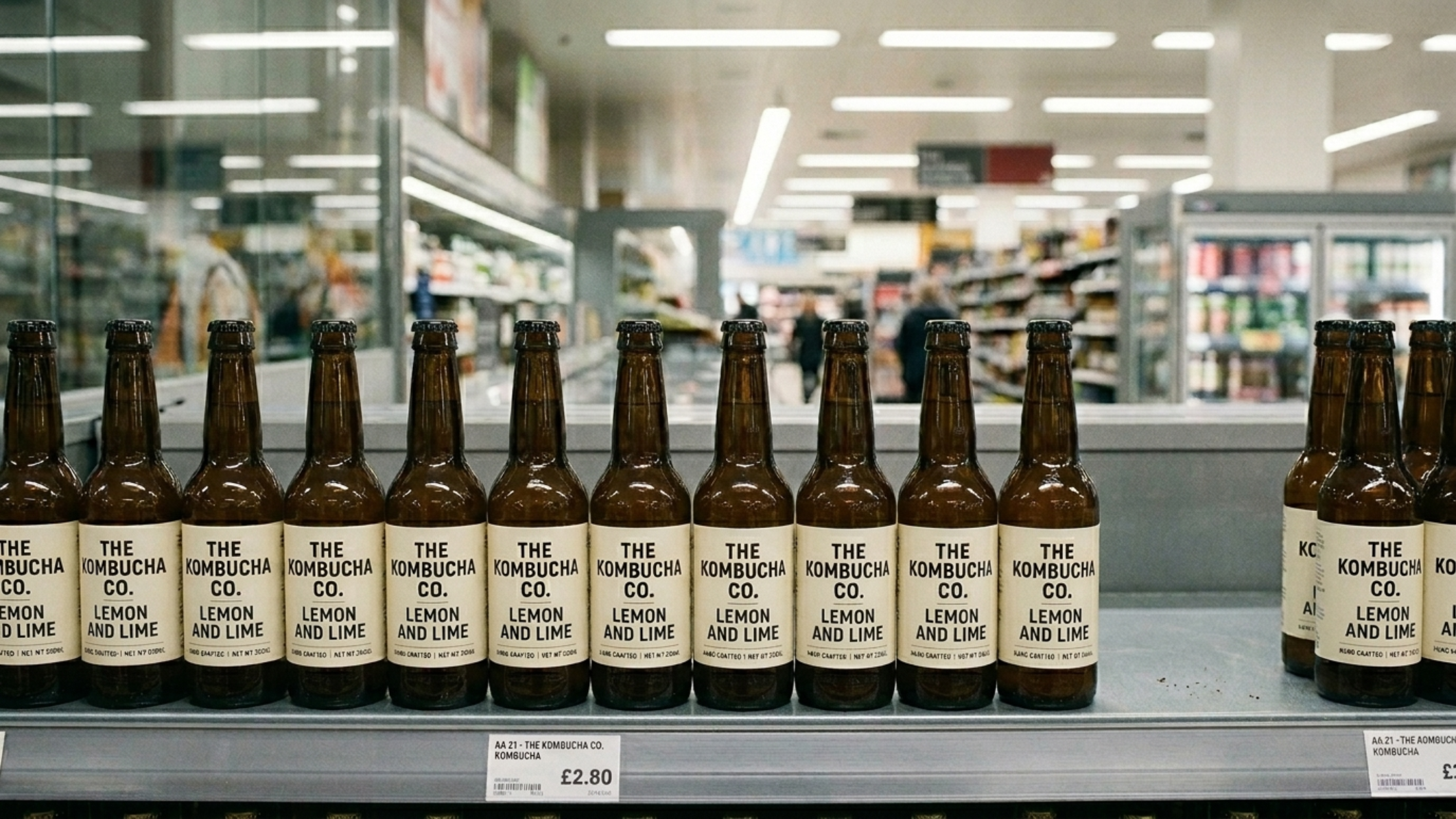
When Your Production Model Doesn't Match Your Market Position
Moving between sub-categories isn't a natural progression. It needs a deliberate rebuild - different batch sizes, different co-packing relationships, different ABV management protocols, and often different certification requirements depending on the retailer and geography you're targeting. The brands that treat it as a gradual process usually find out the hard way that it isn't.
Take the sugar-free functional sub-category. Hitting less than 0.5g of sugar per 100ml and holding it - across thousands of litres - needs control at the ingredient level, not just monitoring at the finished product stage. Residual sugars vary in traditionally brewed kombucha. A batch that tests clean today is no guarantee the next one does.
One failed labelling audit can cost a retail account that took two years to earn. We've addressed the formulation approach in our guide on how to formulate low-sugar kombucha without sacrificing flavour.
Mainstream volume presents a different kind of challenge. The production model that works at craft scale is rarely co-packer-compatible without adaptation - and SKU flexibility, reduced fermentation complexity, and predictable lead times are the things that actually unlock co-packing relationships and regional growth. Our piece on how to scale kombucha production without losing control is a good starting point if you're navigating that transition.
Private label sits at the extreme end of that operational demand. Retailers commissioning own-brand kombucha need a supplier who can hit spec every run without exception - and the quality story needs to run from the ingredient inward. Traceability, certification, batch consistency records create the wins and keep those contracts.
The Positioning Traps Worth Knowing About
The most common production problem in this category isn't technical failure. It's misalignment - a brand building toward one tier while operating infrastructure designed for another.
The premium brand that's aiming for mainstream retail is a common version of this. The label story is artisanal. The retail ambition is five hundred stores. But batch variation means the product experience doesn't hold at scale - and premium positioning without premium consistency is a commercial contradiction that retailers spot quickly.
There's also the reverse: brands with genuine mainstream volume ambition that have priced and positioned correctly, but whose entire production model was designed around craft batch sizes. The unit economics that work at 500 litres a week simply don't work at 5,000. Co-packing is the bridge - but only if your recipe was designed for co-packing compatibility before you needed it.
And then there are the functional brands where the formulation drifts. When your health claim is the product, consistency isn't just a quality issue - it's a legal one. Sugar or ABV figures that shift across batches put everything at risk: the claim, the listing, and the years of distribution work behind it.
There's No Wrong Sub-Category - Only Misaligned Infrastructure
Any of the six positions can be a winning commercial strategy. The category is large enough, and growing fast enough in enough global markets, that there's real opportunity at every point on the landscape.
What determines whether your brand captures that opportunity isn't just the positioning decision. It's whether your production infrastructure was built to match it.
Good Culture fermented bases are used across every sub-category. Premium artisanal brands use them for the consistency and fermentation depth that's genuinely difficult to achieve reliably at craft scale. Mainstream volume brands use them for the co-packer compatibility and cost-efficiency that make accessible price points commercially viable. Private label programmes use them because the certifications - SQF/GFSI, Organic, Kosher, Halal - come with the ingredient, rather than needing to be built from scratch.
The starting point is knowing which sub-category you're building for. Everything else follows from there.
Frequently Asked Questions
How many distinct sub-categories exist in kombucha today?
Six: Premium/Traditional, Craft-Style, Mainstream Volume, Sugar-Free/Functional, Hard Kombucha, and Private Label/Value. Each has its own price architecture, consumer profile, and production requirements - and the demands of each are genuinely different.
What price points are moving fastest in mainstream retail?
Products priced under $3.00/£2.00 are moving two to three times faster than those above $4.00 at mainstream US and UK retailers. The mainstream volume sub-category is where the highest growth by unit volume is currently concentrated.
Can a brand operate across multiple sub-categories?
Yes - some brands do this deliberately, with a premium hero product and a mainstream sub-range. But each sub-category needs its own production model. The most common mistake is assuming the same infrastructure serves both without adaptation.
What makes private label kombucha commercially attractive today?
Consistent volume, reliable quality documentation, and certified ingredient supply. Retailers commissioning own-brand kombucha at scale are buying the production system as much as the product - and the brands that win those contracts have built their ingredient foundation with that scrutiny in mind.