

For a decade, kombucha was a market you could enter on enthusiasm alone.
A SCOBY, a story, and a health-conscious consumer base in the right location was enough to build a business. Home-brew credibility was a differentiator. Inconsistency was, if not forgiven, at least tolerated. The early adopters were patient. And they understood the product. But for products at scale, that window has closed.
The global kombucha market crossed $5.5 billion in 2026, growing at a steady 13-14% a year. It's becoming a global heavyweight. And heavyweight categories play by different rules.
The question isn't whether kombucha has made it. It has. The question is whether your operation is built for the market that exists now, not the one from five years ago.
Why Scale Changes Everything for Kombucha Producers
There's a version of this story that gets told as a straight line. Kombucha goes from the health food shop shelf to mainstream supermarket fridges, consumers follow, market grows. Clean, simple, done. But the actual reality is more demanding.
Scale doesn't just bring more consumers. It brings way more scrutiny. A retailer listing kombucha across hundreds of stores isn't just making a flavour decision. They're making a supply chain decision. A compliance decision. A certifications decision. And increasingly, they're making those decisions before the conversation about price even starts.
FoodNavigator named gut health among the top food and beverage trends for 2026, which is also driving demand. But demand on its own doesn't win you listings. What does is the ability to supply consistently against those demands. That means products that hold to spec every run, every week, every season.
The brands that understood this early are the ones capturing the best retail windows right now. The brands still operating on early-adopter assumptions are seeing those same windows close.
For the full picture on where the market is heading, our 2026 Global Kombucha Report is a free resource worth downloading before you read on.
How Mainstream Retail Has Raised the Bar for Kombucha Brands
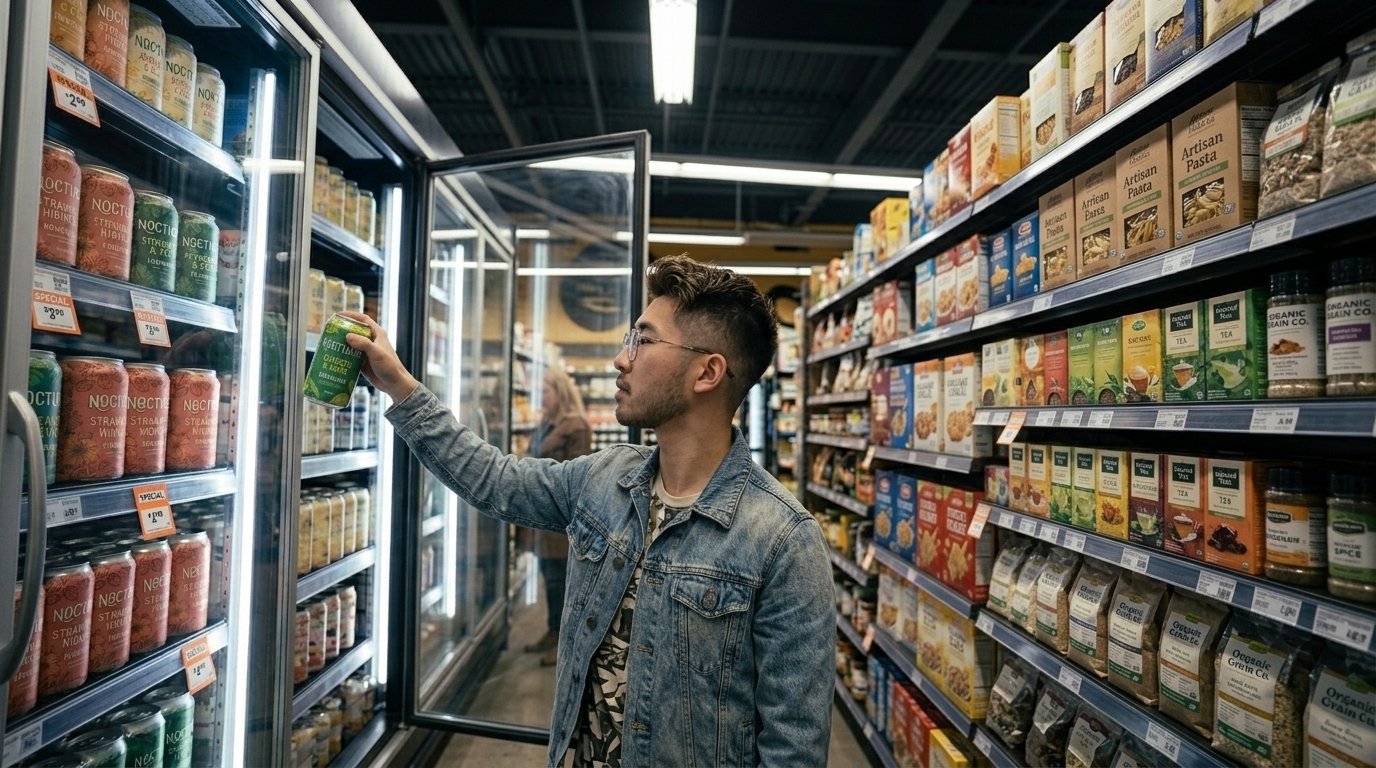
The clearest signal of where the category has moved is structural. In North America, nearly 60% of kombucha sales now run through supermarkets. That's the proof point. Kombucha has become part of the weekly shop, and not just a specialty health buy. And the consumer reaching for it in a mainstream supermarket isn't the same consumer who discovered it in a juice bar in 2016.
Their expectations are different. Their tolerance for inconsistency is lower. And the retailer supplying them has zero patience for recalls, reformulations, or off-spec batches.
Europe tells a related story but through a different channel. Here, a lot of the market is hospitality-first, with nearly 61% of volume consumed in cafés, bars, and restaurants. Germany leads European revenue, while France and Eastern Europe are the fastest-growing markets. The route to the shelf runs through the menu first, but the operational bar to supply either channel reliably is the same.
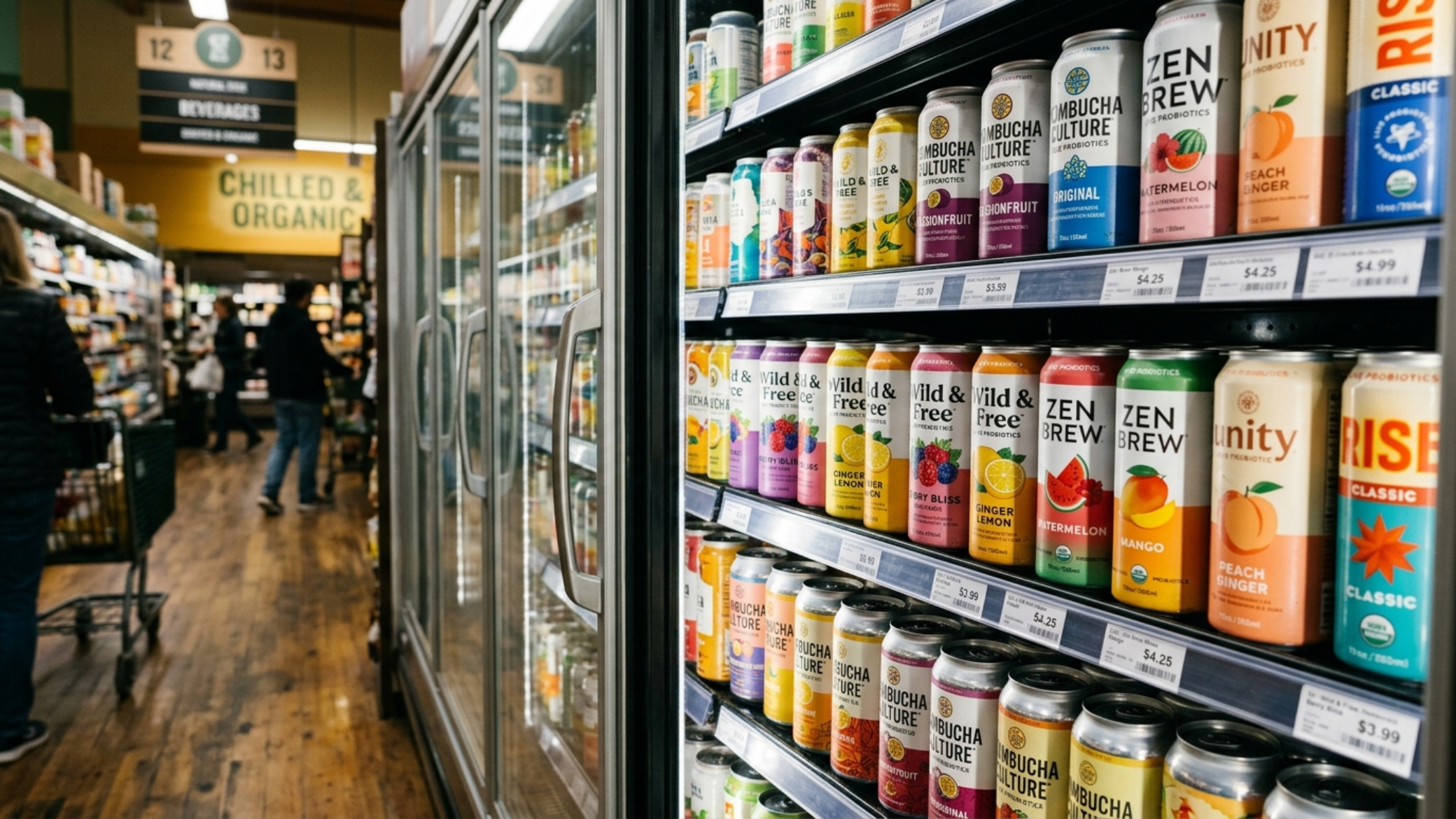
Lipton Kombucha entering the mainstream is the clearest signal yet. When a brand of that scale commits to the category, it accelerates consumer education for everyone while raising the operational bar. You can't be the artisanal alternative to Lipton if your product doesn't hold to the quality standard mainstream retail now expects.
Major retailers are increasingly requiring SQF/GFSI, Organic, Kosher, or Halal accreditation as a baseline condition of supply. Not a nice-to-have. Without them, the conversation doesn't start. Our piece on why certifications unlock retail opportunities for beverage manufacturers covers what that means in practice.
The Category Is Both Mature and Just Getting Started
The honest answer to whether kombucha has matured is: both, depending on where you're looking. It helps to think about what happens to a category as it grows up.
Phase one is early adoption. Enthusiasm and novelty carry significant weight. Natural channel only. Premium pricing. Consumers are curious and forgiving. Batch variation is noticed but not punished.
Phase two is growth. Distribution expands. New entrants arrive. Pricing pressure begins to build. Retailers start setting basic conditions.
Phase three is the maturity threshold. Scale is expected as standard. Quality is non-negotiable. Certification unlocks access. The brands without operational infrastructure begin losing listings, regardless of how strong their story is on the label.
North America sits closest to phase three. With most volume now moving through mainstream retail, the infrastructure requirements and the supply chain scrutiny are all characteristic of a category that has crossed into maturity.
Europe tells a different story. As we covered in our 2026 Global Kombucha Report, most Europeans still haven't tried kombucha, but 85% say they'd try it if offered in a social setting. That's an enormous untapped audience. Asia Pacific is growing fastest of all, at roughly 14.4% CAGR, with markets like South Korea and China posting far steeper individual growth rates. These are phase-one and phase-two markets with a lot of runway still ahead.
The opportunity isn't closing, but it is dividing. In mature markets, the window belongs to producers who can meet the operational standard. In emerging markets, first-mover advantage still exists, but only for brands with the production infrastructure to supply at scale when the demand arrives.
Most producers know where they stand, at some level. The gap isn't always visible until a retailer asks for documentation you don't have, a batch fails ABV testing, or a major listing goes to a competitor who could simply supply more reliably. Our Kombucha Producer's Guide walks through exactly what mainstream retail now expects of a production operation — worth a read if you're auditing where you stand before that conversation arrives.
For a deeper look at the ABV compliance challenge specifically, our guide on how to control alcohol in commercial kombucha production covers the risk and the practical approach in detail.
Why the Brands Winning Listings Aren't Always the Biggest
This isn't an argument that only large, well-funded operations can succeed in the current market. It's the opposite.
Take the brand we worked with that needed to jump from independent retailers to a major national supermarket listing. That kind of jump usually breaks a supply chain. The volume requirement is massive and it's immediate. Most brands face a choice between millions in CAPEX for new tanks or turning the listing down.
They didn’t have to choose either. By building on our fermented bases, they scaled production capacity overnight and met the volume demands of the listing while holding their premium craft flavour profile at mass-market scale. That's what winning looks like in a mature category.
The brands capturing the best windows in 2026 are doing so with lean operations built on consistent foundations. Disciplined cost structures. Production efficiency. And the ability to say yes to a listing without rebuilding the factory to honour it.
We've explored what inconsistency at the batch level really costs in our piece on the hidden costs of inconsistent kombucha production. The short version: more than most operations have accounted for.
The Infrastructure Gap Is the Real Competitive Gap in 2026
In the early-adopter phase, the gap between winning brands and struggling brands was usually a product gap. Better flavour, more authentic story, or more interesting ingredients.
That gap still matters. But in 2026, the more decisive gap is operational. Consistent sensory profile. Stable ABV across every run. Documented quality certification that opens the doors major retailers require opened before they consider a range decision. Those three things are the foundation a modern kombucha operation is judged on, and our Kombucha Producer's Guide breaks down what each one demands in practice.
The brands that have used Good Culture fermented bases to reach major retail listings have done so by building on a foundation engineered for exactly this environment. It means that fermentation depth and acidity profiles are locked in at the ingredient level. They’re also certified to SQF/GFSI, Organic, Kosher, and Halal standards. Our high-strength bases reduce logistics cost and scale without a rebuild.
The winners aren’t just making good kombucha. They're making it the same way, every time, with the documentation to prove it. That's what phase-three retail demands. And that's what the brands currently capturing the best listings are delivering.
The window is open. The question is whether your operation is built to step through it. If you're auditing where you stand, the Kombucha Producer's Guide is the place to start. And if you're ready to talk specifics, schedule a call with our team.
Frequently Asked Questions
Is the early adopter phase of kombucha really over?
In the most established markets, particularly North America, yes. With nearly 60% of sales now running through mainstream supermarkets, the commercial conditions of a mature category are in place: certification requirements, supply chain scrutiny, and pricing pressure that didn't exist five years ago. But in Europe, Asia Pacific, and emerging markets, significant early-mover opportunity remains for brands with the operational infrastructure to support it.
What certifications do kombucha producers need for mainstream retail today?
Major retailers are increasingly requiring SQF/GFSI certification as a baseline, alongside Organic, Kosher, or Halal accreditation depending on the channel and geography. Without these, many retail conversations don't begin regardless of the product's quality.
Where is kombucha growing fastest right now?
Asia Pacific leads global growth at roughly 14.4% CAGR, with individual markets like South Korea and China posting much steeper rates. In Europe, Germany leads on revenue while France and Eastern Europe are the fastest-growing markets, and most of the continent remains untapped: the majority of Europeans haven't tried kombucha yet, but 85% say they would if offered it socially.
Sources
FoodNavigator — Top 5 Functional Food & Beverage Trends for 2026 — https://www.foodnavigator.com