
Why Kombucha Manufacturing Lead Times Are A Structural Problem - And How To Fix Them
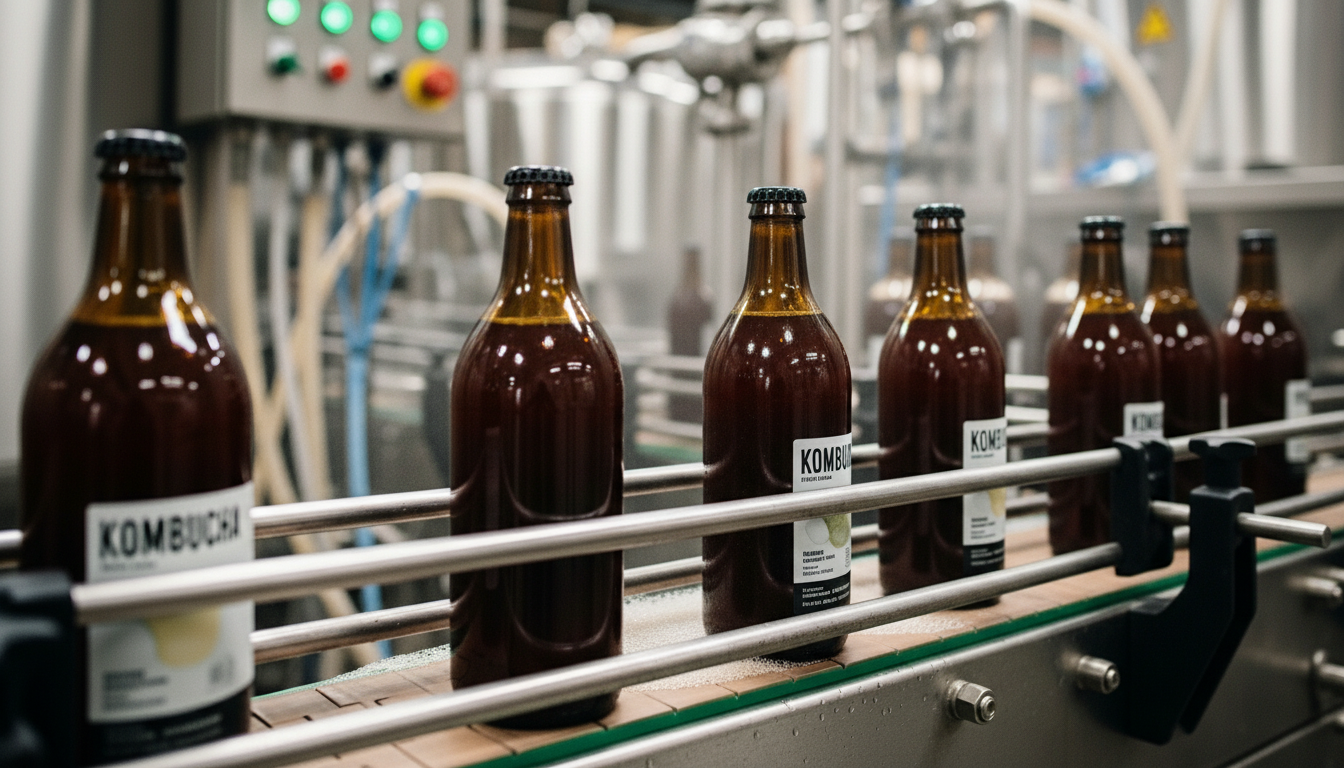
Ten to fourteen days. That's the minimum production cycle for a batch of commercially brewed kombucha, and it's largely non-negotiable.
No matter how well the plant runs, how tightly the schedule is managed, or how experienced the team is, the biology of fermentation sets the floor. When demand spikes, when a retailer needs a faster turnaround, or when a new SKU needs to be in market ahead of a competitor, that floor becomes your ceiling.
Most kombucha manufacturers respond by optimising around it. Think staggered brewing schedules. Better tank utilisation. Tighter QA processes. These are sensible moves. But they don't change the underlying constraints. They just make it more manageable. This article covers why that distinction matters, and what a different production model makes possible.
Breaking Down The Kombucha Manufacturing Cycle
A standard kombucha production cycle breaks down roughly like this:
Tea brewing and cooling: 2–4 hours
Primary fermentation: 7–14 days
Secondary fermentation (flavouring and carbonation): 2–5 days
Filtration, QA, and packaging: 1–2 days
Add it up, and a conservative end-to-end cycle is 10 days. A more cautious one, with additional testing at the fermentation stage, runs to three weeks or more.
The bottleneck is obvious. Primary fermentation accounts for 70–80% of total production time, and it can’t be meaningfully compressed without compromising the product. If you push the temperature too high, the flavour profile shifts. Reduce the cycle time too aggressively and acidity targets drift. Unfortunately, the SCOBY operates on its own schedule.
Why Process Optimisation Only Goes So Far
Staggered brewing, starting a new batch every day rather than all at once, is the most common operational response. It smooths out throughput, keeps packaging lines busier, and creates a more predictable production rhythm. A facility running five 200L batches simultaneously gets one harvest per fortnight. The same facility staggering one batch per day harvests daily by week three.
That's a genuine improvement. But it's not a lead-time reduction.
The per-batch cycle hasn't changed. What's changed is the scheduling around it. If a customer needs a specific product with 48 hours' notice, staggered brewing helps only if the right batch happens to be ready. If it isn't, the answer is still the same - wait.
Temperature adjustments offer marginal gains. Raw Brewing Co's fermentation research notes that brewing at the warmer end of the optimal range can roughly halve fermentation time under ideal conditions. But even halving a 14-day cycle still leaves you with a 7-day cycle. And achieving that consistently at commercial scale, across different product lines and seasonal variation, adds its own operational complexity. You’re trading one problem for another.
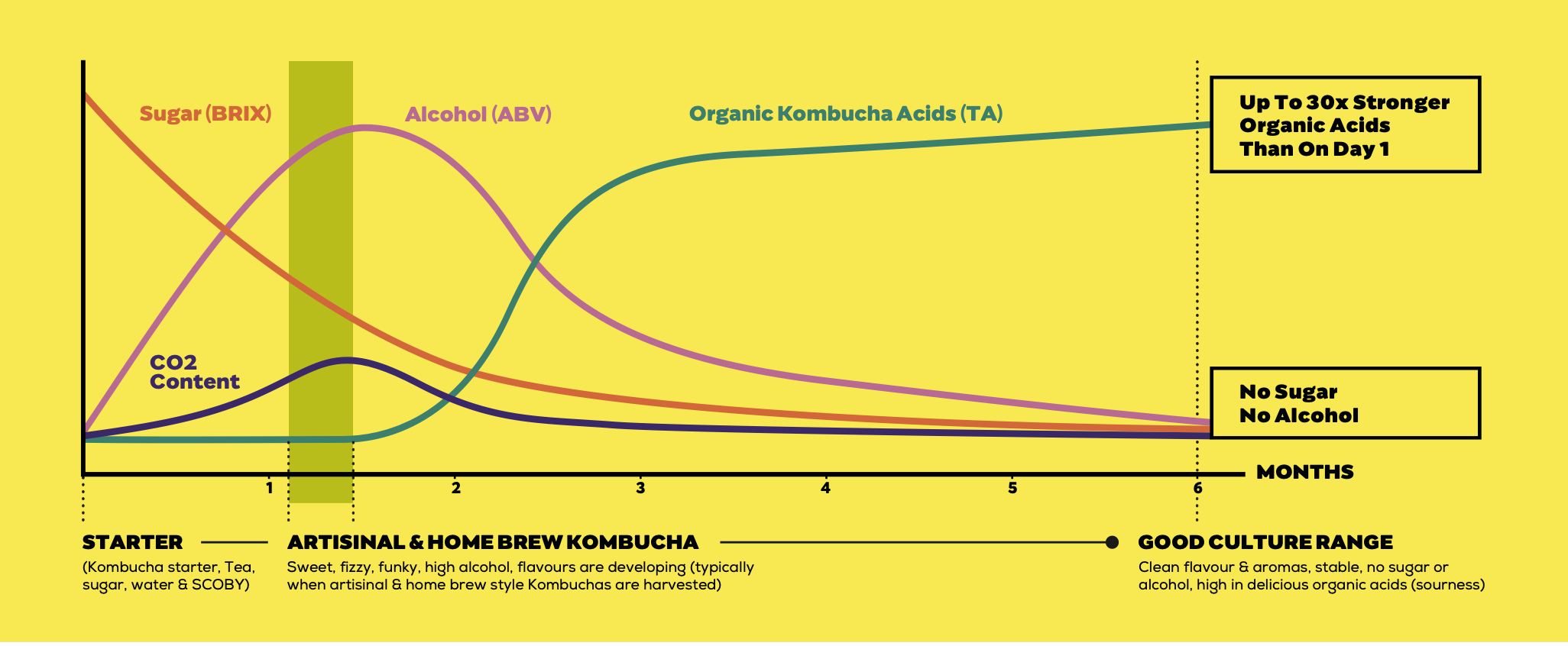
Here’s an outline of how the fermentation process works for our Good Culture range of fermented bases.
What Happens When Fermentation Leaves Your Kombucha Manufacturing Process
If fermentation is the bottleneck, and fermentation cannot be eliminated, what happens when it's moved?
Not eliminated from the product. The fermentation character, the organic acids, the probiotic profile, all of that remains. Moved out of your facility, to a specialist producer operating at scale, under controlled conditions, with full traceability and certification built in.
The ingredient that arrives at your plant is a pre-fermented base. Microbiologically stable. Consistent pH and acidity. Already certified, organic, kosher, halal where needed. Already compliant with ABV thresholds, and with documentation to prove it.
What remains in your facility: blending, flavouring, carbonation, packaging. That’s a production cycle that can be compressed to one or two days.
That's not a marginal improvement. It’s an altogether different production model.
The Knock-On Benefits: Capacity, Compliance, And Consistency
Lead time gets the headlines, but the downstream effects are worth understanding clearly.
When fermentation leaves the production cycle, tank capacity doesn't shrink - it multiplies. Vessels that were tied up for two weeks per batch can now turn in two days. The same physical footprint produces substantially more volume. As we've seen across the manufacturers we work with, pre-fermented bases have allowed operations to increase effective throughput by up to 30x from their existing assets.
ABV compliance becomes structural rather than managed. In-house fermentation requires ongoing monitoring, because live cultures continue producing alcohol during storage and transit if they’re not handled correctly. But a fully fermented base arrives with fermentation complete. There's no residual yeast activity to monitor. Compliance is built into the ingredient, instead of being maintained by the QA team.
Batch-to-batch consistency improves as a direct consequence. The largest source of variation in kombucha manufacturing is the fermentation stage - culture drift, temperature fluctuation, SCOBY health. Remove that stage from your process and the variation comes with it.
Making The Transition Work In Practice
The practical question is usually: what does this actually change in our facility?
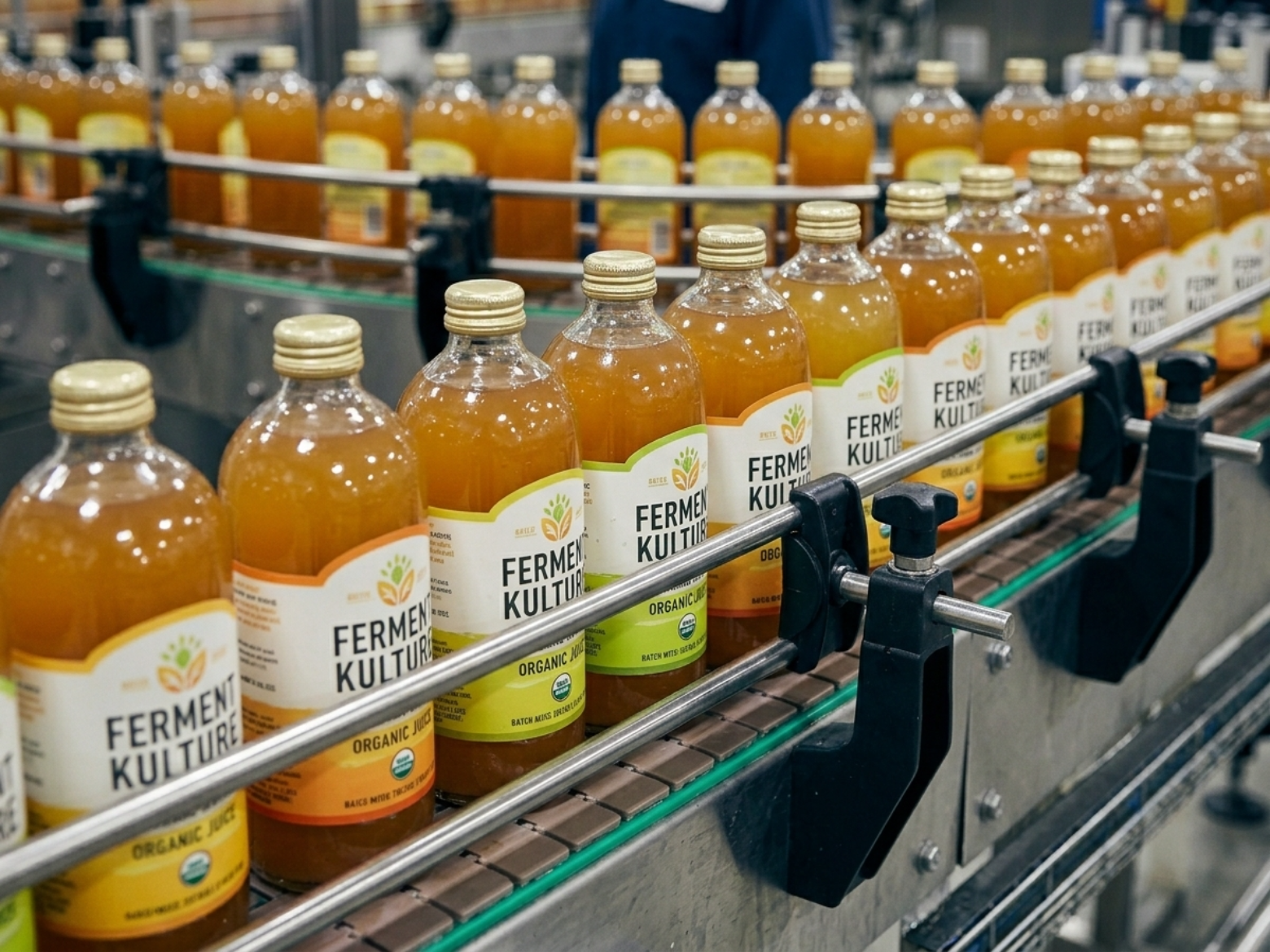
More than people expect, and less than they fear. Formulation stays yours. The product profile, the flavour strategy, the botanical choices - none of that is outsourced. What changes is the starting point. Instead of beginning with tea and a SCOBY, you begin with a certified fermented base that's diluted and blended to spec.
The shift does require reformulation work upfront. Existing recipes need to be re-calibrated around the base's flavour and acid profile. Good Culture's application team works through this as part of onboarding. As we documented in our Kombucha Troubleshooting Guide, one co-packer R&D team developed a full kombucha range from brief to commercial recipe in six weeks using this model.
Lead times for the ingredient itself are also worth factoring in. Stock is held across multiple warehouse locations, with delivery times typically measured in days. For manufacturers managing seasonal demand or tight retailer windows, that supply availability matters as much as the production cycle reduction.
For teams weighing this seriously, our Kombucha Scale Playbook covers the capacity and throughput mechanics in more detail.
Long kombucha manufacturing lead times are not a sign that a production team isn't good enough. They're a sign that the production model has a structural constraint. Optimisation addresses the symptoms. A different model addresses the cause.
Manufacturers running pre-fermented bases aren't producing inferior kombucha. They're producing it faster, more consistently, and from a smaller capital base, with compliance documentation that retail buyers increasingly expect as a baseline.
The question isn't whether the shift is possible. It's whether the kombucha manufacturing model you're running is still the right one for where the business needs to go.
Discuss your production scaling challenges with a GC solutions expert →
Frequently Asked Questions
What is a typical kombucha production lead time for commercial manufacturers?
Most commercial kombucha producers operate on a 10–21 day production cycle from start to packaged product, with primary fermentation accounting for the majority of that time, typically 7–14 days depending on recipe, temperature, and target flavour profile. Secondary fermentation, filtration, QA, and packaging add a further 3–7 days in most facilities.
Can kombucha fermentation be sped up without affecting quality?
Marginal reductions are achievable through temperature optimisation, but gains come with trade-offs. Fermenting at the warmer end of the optimal range can roughly halve fermentation time, but increases the risk of flavour drift, excess acidity, and ABV instability. Meaningful lead-time reduction requires a different approach to where fermentation happens, not simply how fast it runs.
What is a pre-fermented kombucha base and how does it work in commercial production?
A pre-fermented kombucha base is a concentrated, shelf-stable ingredient produced through controlled fermentation by a specialist supplier. It arrives at the manufacturer's facility already acidified, microbiologically stable, and certified for ABV compliance. The production team dilutes and blends it with flavour components, tea infusions, botanicals, juice concentrates, then carbonates and packages. This compresses the active production cycle from 10–21 days to 1–2 days.
Does switching to a pre-fermented base affect the authenticity or certification of the finished product?
No. The fermentation character, organic acids, and probiotic profile all originate from genuine long fermentation. The process is simply carried out upstream by the ingredient supplier rather than in the manufacturer's own facility. Certified organic, kosher, and halal bases pass their certification status through to the finished product, provided the other ingredients are also compliant. Documentation for retail and regulatory purposes is typically supplied by the ingredient manufacturer.
How does using a pre-fermented base affect tank capacity and throughput?
Because the fermentation phase is removed from the production cycle, vessels that previously held batches for two weeks can now turn in one to two days. This dramatically increases throughput from the same physical asset base, without additional capital expenditure on fermentation vessels. For manufacturers facing capacity constraints, the effective output increase from existing equipment can be substantial.
Sources
Raw Brewing Co — Kombucha Fermentation and Temperature — https://kombucha.com/blogs/kombucha-101-general-knowledge/kombucha-fermentation-and-temperature