
The Kombucha Producer's Guide: Commercial Recipes, Process Flows & Market Insights
Get the 2026 Kombucha Producer’s Guide
Your free commercial and technical roadmap for the 2026 market.
> Clear, step-by-step roadmaps to the 2026 global heavyweight category
> Tips, ideas, and infrastructure to launch and scale without the technical risk
> Bold, category-leading taste and innovation to create your next winning drink
> 8 proven, real-world, inspired sample recipes
What Commercial Kombucha Production Actually Requires
The kombucha brewing process is deceptively simple on paper. Tea, sugar, water, a SCOBY, time. But anyone who has tried to scale beyond a pilot batch knows the gap between a great homebrew and a commercially viable, retail-ready product is enormous.
Batch variability. Alcohol control. Shelf stability. Capacity constraints. These aren't edge cases - they're the ceiling that stops ambitious brands from growing.
The Kombucha Producer's Guide was built for the people who've hit that ceiling, or who want to avoid it entirely. It covers the full commercial production process: from understanding where your brand fits in the market landscape, to eight proven recipes with step-by-step process flows, ingredient ratios, and production notes you can take directly to your facility.
What's Inside the Guide.
This isn't a kombucha primer. It's a commercial production reference - built for manufacturers, co-packers, R&D teams, and brand founders who need technical depth alongside market context.
-
Where the global category stands, which regional markets are moving fastest, and how to identify the positioning that gives your brand room to grow. Includes the full kombucha market spectrum — from premium traditional through to sugar-free functional, hard kombucha, and private label — with price points, target consumers, and production approaches mapped for each.
-
A clear-eyed look at what makes commercial production different from artisanal brewing. Covers the organoleptic challenge, how to start from a consistent fermented base, and why flavour development is where category-leading brands are actually won.
-
Each recipe is built for a 1,000-litre batch volume, includes exact ingredient ratios, production time, shelf life, ABV, and a step-by-step process flow. Styles covered:
Premium Kombucha — Blueberry & Vanilla
Traditional Kombucha — Calabrian Clementine
Craft-Style Kombucha — Classic Ginger
Mainstream Kombucha — Raspberry Lemonade
Sugar-Free Kombucha — Pink Lemonade
Hard Kombucha — Cherry Berry
Kombucha Slushy — Citrus Slap
Kombucha Post-Mix — Pina Colada
-
An introduction to the four standardised fermented bases that underpin every recipe in the guide — with sensory profiles, strength comparisons, and guidance on which base suits which production style.
-
Six case studies of brands rewriting the rules of the category — from AI-assisted fermentation to the world's first halal-certified gold award winner.
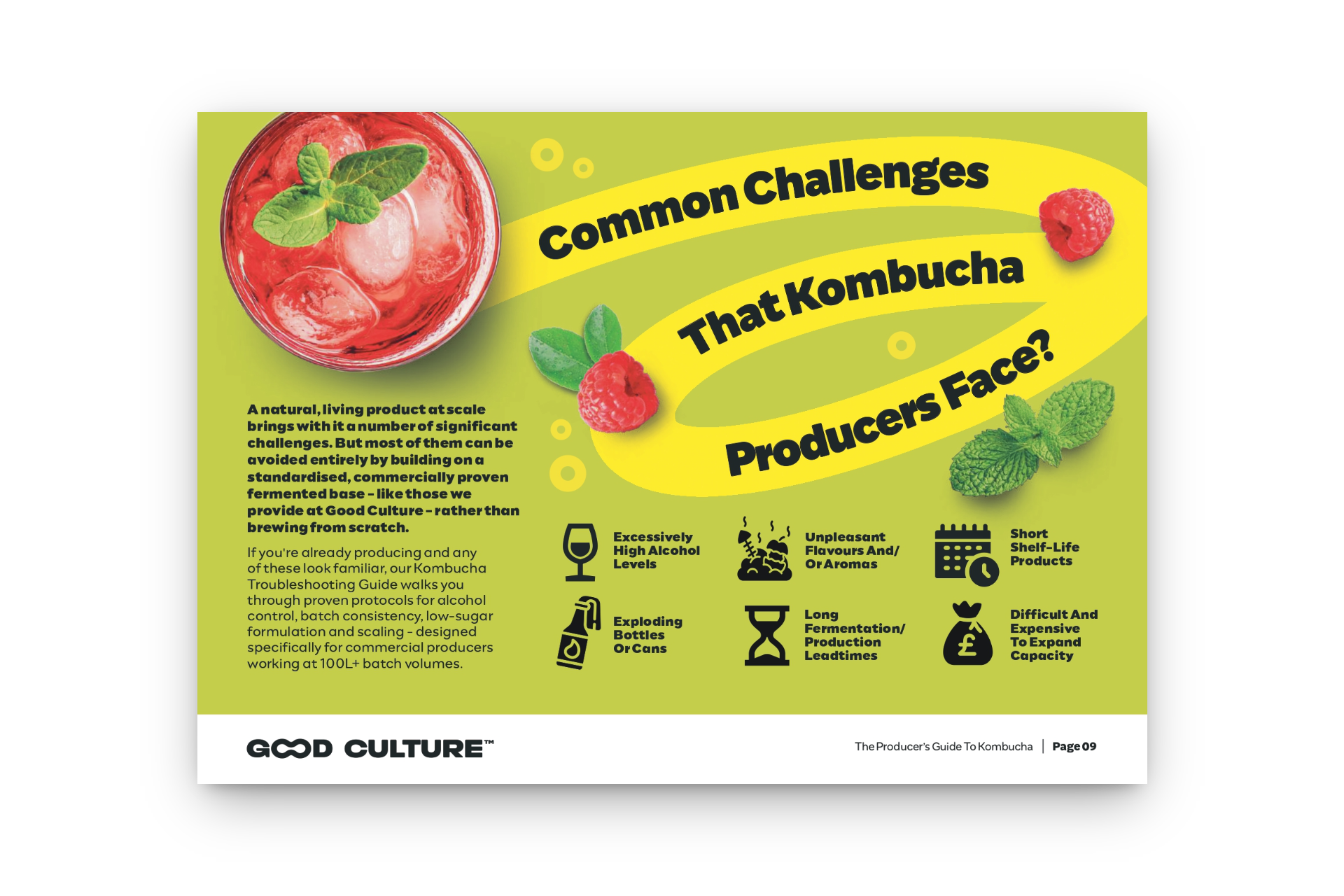
The Challenges Kombucha Producers Actually Face
Scaling kombucha production without the right foundation creates predictable problems. Most of them share a common root: starting from scratch with a live, unpredictable fermentation rather than a standardised, commercially proven base.
Excessively high alcohol levels are one of the most commercially damaging. In most markets, kombucha must remain below 0.5% ABV to avoid alcohol duty and retail compliance issues. Without tight process control, alcohol can creep — and a non-compliant batch is product you can't sell.
Exploding bottles or cans happen when secondary fermentation isn't properly managed. The result is product loss, customer complaints, and in a worst case, a retail delisting.
Short shelf life limits distribution reach and increases wastage costs. Brands targeting retail channels need 6–12 months ambient or chilled stability as a baseline — which requires a production process engineered for consistency from the start.
Long fermentation and production lead times make it difficult to respond to demand changes. Traditional kombucha brewing takes weeks to months. Brands that can't flex quickly lose orders.
Expensive capacity expansion is the wall many growing brands hit. Adding fermentation capacity the traditional way means significant CAPEX — tanks, infrastructure, space, and trained labour.
The guide addresses each of these directly, with production frameworks that remove the guesswork and a fermented base approach that cuts lead times from months to a single day.
Who This Guide Is For
The guide is designed for three types of people — and it'll be useful to anyone who recognises themselves in one of these:
-
You understand that a great recipe is the starting point, not the finish line. You need a production process that's scalable, compliant, and commercially viable from day one — not something you'll have to rebuild at 10,000 litres.
-
Batch inconsistency, alcohol compliance issues, capacity ceilings, rising COGS — these are engineering problems, not brand problems. The guide walks through the frameworks that solve them.
-
Co-packers, manufacturers, and brand owners in adjacent categories are increasingly looking at kombucha and functional fermented drinks as a growth opportunity. The guide gives you the market context and production blueprint to evaluate the opportunity clearly.
The Kombucha Brewing Process:
Why the Base Changes Everything
Most kombucha starts the same way. Sweetened tea is inoculated with a SCOBY, fermentation begins, and over weeks or months, bacteria and yeast convert sugars and alcohol into organic acids. The result — when it works — is a naturally effervescent, slightly sour, functional drink with a genuinely complex flavour profile.
The problem is that "when it works" is doing a lot of heavy lifting in that sentence.
Consistency is the real challenge of commercial kombucha production. The SCOBY is a living organism. Temperature, water quality, sugar concentration, tea strength, and fermentation time all influence the final product. A batch that's perfect in spring can taste different in winter. A recipe that works at 100 litres often behaves differently at 1,000.
This is why the most commercially successful kombucha brands don't start from a SCOBY. They start from a standardised, long-fermented base - one that has already completed the difficult, unpredictable first fermentation stage under controlled conditions, and arrives at the production facility with a locked-in acidity profile, zero residual sugar, and alcohol below 0.5%.
The practical result is significant. Production time drops from weeks to one day. Batch-to-batch variation is eliminated. Alcohol and sugar compliance is built in before you've added a single flavour ingredient. And capacity scales from existing mixing and carbonation equipment, without new fermentation infrastructure.
This is the production model behind every recipe in the guide. It's also the model used by brands currently listed in Walmart, Tesco, Costco, Whole Foods, and Sainsbury's.
Frequently Asked Questions
-
All eight recipes in the guide are built around a 1,000-litre batch volume — the threshold at which commercial production economics start to make sense for most manufacturers and co-packers. Each recipe includes ingredient volumes as a percentage of total volume, so they can be scaled up or down while maintaining the correct ratios.
-
The core brewing process is the same — tea, sugar, water, and a fermentation culture. The differences are in consistency, compliance, and scalability. Commercial production requires stable ABV (typically below 0.5% to meet retail and tax requirements), predictable shelf life, and the ability to replicate the same product across batches of varying sizes. The guide covers each of these dimensions, with production frameworks designed specifically for commercial volumes.
-
No. The recipes in the guide are built around ready-to-blend fermented bases rather than in-house SCOBY fermentation. This means the production process requires standard beverage mixing, filtration, and carbonation equipment — not dedicated fermentation tanks. It significantly lowers the CAPEX threshold for entering the category.
-
Most of the recipes in the guide target 6–12 months chilled shelf life for raw and unpasteurised product. The sugar-free and post-mix formats achieve 12 months ambient stability. Shelf life is influenced by carbonation levels, filtration, sugar content, and whether the product is pasteurised — all of which are covered in the relevant recipe notes.
-
Yes. The guide includes eight distinct production styles — from premium craft through to mainstream volume and hard kombucha — each with different flavour profiles, ingredient approaches, and distribution formats. Within each style, ingredient ratios can be adjusted to hit target flavour, acidity, and sweetness profiles. The guide notes the specific parameters to adjust and the sensory effect of doing so.